


 PLATFORM UPDATE:


Vanadyl complexes supported by O,O- and N,O-chelate ligation: structures and polymerization catalysis
 b
and
Carl
Redshaw
*cd
b
and
Carl
Redshaw
*cd
Abstract
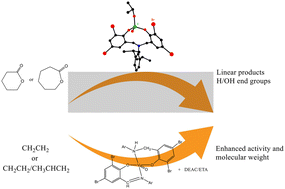
Reaction of dibromosalicylic aldehyde and 2,6-diisopropylaniline, followed by sodium borohydride, and 2-chloromethylpyridine hydrochloride/triethylamine, and then [VO(OiPr)3] led to [VO(L)(LH)] (where L = 2,6-iPr2C6H3N![[double bond, length as m-dash]](https://www.rsc.org/images/entities/char_e001.gif) CH-2-(O)-C6H2Br2-3,5) (1) as the major product, together with ca. 10% of [VO(OiPr)(L′)] (where L′ = {[(2-(O)C6H2Br2-3,5)CH2]2(μ-NC6H3-iPr2-2,6)} (2)). Similar use of [VO(OEt)3] led to 1 and [VO(OEt)(L′)] (3). Use of excess [VO(OiPr)3] also led to the isolation of 2 plus [VO(L)(LH)] (4), which is related to 1 but with intramolecular H-bonding present. On changing the ratio of dibromosalicylic aldehyde and 2,6-diisopropylaniline to 2 : 1, further reaction with [VO(OiPr)3] afforded two polymorphs of [VO(L)2] (5 and 6). When 2,6-dimethylaniline was employed in a similar synthesis to LH, the product isolated with [VO(OiPr)3] was [VO(L″)2] (7) (where L″ = 2,6-Me2C6H3NCH-2-(O)-C6H2Br2-3,5). The procedure employed for 1 was extended to 3,5-dichlorosalicylic aldehyde and afforded two polymorphs [VO(L)2] (8τ = 0.07, 9τ = 0.16) (where L = 2,6-iPr2C6H3CHN-2-(O)-C6H2Cl2-3,5). Use of 3,5-diiodosalicylic aldehyde led to [VO(L)2]·MeCN (10·MeCN) (where L = 2,6-iPr2C6H3CHN-2-(O)-C6H2I2-3,5). The intermediate compounds [2,6-iPr2C6H3NCH-2-(OH)-C6H2Br2-3,5)] (LH), [(2,6-iPr2C6H3NHCH2-2-(OH)-C6H2Br2-3,5)] (LH2) and the salt {[(2-(O)C6H2Br2-3,5)CH2][(2-(OH)C6H2Br2-3,5)CH2]2(μ-NC6H3-iPr2-2,6)}[Et3NH]([L′H][Et3NH]) have also been characterized. Complexes 2, 3, 5, 8, and 10 have been screened as catalysts for the ring opening polymerization (ROP) of ε-caprolactone (ε-CL) and δ-valerolactone (δ-VL). Results revealed high conversions both in solution (130 °C) and as melts. Kinetic runs using ε-CL suggested 3, 5, and 8 performed best, whilst for δ-VL 8 out-performed the other systems; mostly linear polymers with end groups H/OH were formed. Complexes 1 and 2 have been screened as pre-catalysts for the polymerization of ethylene in the presence of EADC (ethylaluminium dichloride) and ETA (ethyl trichloroacetate) and for the co-polymerization of ethylene with propylene. Electron-withdrawing bromo-substituted complex 1 showed markedly enhanced ethylene (co)polymerization activity and polymer molecular weight than previously reported Schiff-base vanadium complexes without an electron-withdrawing group. Complex 2 exhibited activity comparable with 1 and improved thermal stability relative to the previously reported pentavalent bisphenoxy complex without an electron-withdrawing group.
CH-2-(O)-C6H2Br2-3,5) (1) as the major product, together with ca. 10% of [VO(OiPr)(L′)] (where L′ = {[(2-(O)C6H2Br2-3,5)CH2]2(μ-NC6H3-iPr2-2,6)} (2)). Similar use of [VO(OEt)3] led to 1 and [VO(OEt)(L′)] (3). Use of excess [VO(OiPr)3] also led to the isolation of 2 plus [VO(L)(LH)] (4), which is related to 1 but with intramolecular H-bonding present. On changing the ratio of dibromosalicylic aldehyde and 2,6-diisopropylaniline to 2 : 1, further reaction with [VO(OiPr)3] afforded two polymorphs of [VO(L)2] (5 and 6). When 2,6-dimethylaniline was employed in a similar synthesis to LH, the product isolated with [VO(OiPr)3] was [VO(L″)2] (7) (where L″ = 2,6-Me2C6H3NCH-2-(O)-C6H2Br2-3,5). The procedure employed for 1 was extended to 3,5-dichlorosalicylic aldehyde and afforded two polymorphs [VO(L)2] (8τ = 0.07, 9τ = 0.16) (where L = 2,6-iPr2C6H3CHN-2-(O)-C6H2Cl2-3,5). Use of 3,5-diiodosalicylic aldehyde led to [VO(L)2]·MeCN (10·MeCN) (where L = 2,6-iPr2C6H3CHN-2-(O)-C6H2I2-3,5). The intermediate compounds [2,6-iPr2C6H3NCH-2-(OH)-C6H2Br2-3,5)] (LH), [(2,6-iPr2C6H3NHCH2-2-(OH)-C6H2Br2-3,5)] (LH2) and the salt {[(2-(O)C6H2Br2-3,5)CH2][(2-(OH)C6H2Br2-3,5)CH2]2(μ-NC6H3-iPr2-2,6)}[Et3NH]([L′H][Et3NH]) have also been characterized. Complexes 2, 3, 5, 8, and 10 have been screened as catalysts for the ring opening polymerization (ROP) of ε-caprolactone (ε-CL) and δ-valerolactone (δ-VL). Results revealed high conversions both in solution (130 °C) and as melts. Kinetic runs using ε-CL suggested 3, 5, and 8 performed best, whilst for δ-VL 8 out-performed the other systems; mostly linear polymers with end groups H/OH were formed. Complexes 1 and 2 have been screened as pre-catalysts for the polymerization of ethylene in the presence of EADC (ethylaluminium dichloride) and ETA (ethyl trichloroacetate) and for the co-polymerization of ethylene with propylene. Electron-withdrawing bromo-substituted complex 1 showed markedly enhanced ethylene (co)polymerization activity and polymer molecular weight than previously reported Schiff-base vanadium complexes without an electron-withdrawing group. Complex 2 exhibited activity comparable with 1 and improved thermal stability relative to the previously reported pentavalent bisphenoxy complex without an electron-withdrawing group.
 Please wait while we load your content...


