


 PLATFORM UPDATE:


Thermoelectric metal chalcogenides: a platform for anion mixing studies
 a
and
Maarit
Karppinen
*a
a
and
Maarit
Karppinen
*a
Abstract
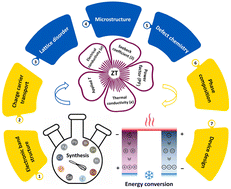
Metal chalcogenides represent state-of-the-art thermoelectric (TE) materials, both in practical TE energy conversion devices and in new TE material research. To further push the performance boundaries of these materials, the major challenge is to suppress the thermal conductivity as much as possible while maintaining high electrical transport properties. The strategies employed to address this challenge include band engineering, chemical composition tuning, and nano- and microstructural modification. Regarding chemical composition tuning, an effective approach specific to metal chalcogenide thermoelectrics is anion mixing through solid solution formation at a chalcogen site, where sulfur, selenium, and tellurium atoms can occupy the same crystallographic site. This perspectival review aims to provide first a wider overview of such possibilities among the metal chalcogenides in general and then highlight the recent research on three currently strongly emerging TE metal chalcogenide families: (i) different binary, ternary and quaternary copper chalcogenides, (ii) ternary cobalt antimony chalcogenides, and (iii) binary silver chalcogenides.
- This article is part of the themed collections: 2026 Frontier and Perspective articles and Spotlight Collection: Mixed-Anion Compounds
 Please wait while we load your content...


