


 PLATFORM UPDATE:


New insights into the photocatalytic properties of composites based on TiO2 and single-walled carbon nanotubes

Abstract
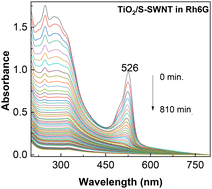
Composites based on TiO2 and single-walled carbon nanotubes (SWCNTs), highly separated in semiconducting tubes (S-SWCNTs) and as a mixture of metallic and semiconducting tubes (M + S-SWCNTs), were obtained by the interaction in the solid state. This interaction induces a change in the size of TiO2 particles from 23.67 nm to 28.2 and 150 nm, respectively, accompanied by an increase in the disorder state of the graphitic lattice of SWCNTs. We demonstrate by UV-VIS spectroscopy that the best performance in terms of rhodamine 6G (Rh6G) photodegradation is obtained in the case of the TiO2/S-SWCNT composite. The highest values of the Rh6G photodegradation efficiency were equal to 92% for an S-SWCNT concentration in the photocatalyst mass of 10 wt% and 94% for a 0.1 mM Rh6G solution with a pH equal to 1. We demonstrate that an important role is played by the O2˙− and ˙OH species in the photodegradation mechanism of Rh6G. This study contributes to a better understanding of the role of metallic and semiconducting carbon nanotubes in the photocatalysis field, highlighting that composites based on semiconducting SWCNTs and semiconducting metallic oxides are those that contribute essentially to the removal of dyes by exposure to the light emitted by a halogen lamp.
 Please wait while we load your content...


