


 PLATFORM UPDATE:


Structural design principles for hybrid cadmium thiocyanate-halides containing bulky organic cations
 a
and
Patrick M.
Woodward
*a
a
and
Patrick M.
Woodward
*a
Abstract
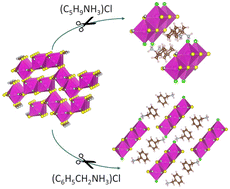
Seven new hybrid cadmium thiocyanate-halide compounds are reported that feature protonated primary amines that are either branched (isopropylammonium, isobutylammonium), cyclic (cyclopentylammonium), or aromatic (benzylammonium, anilinium). All seven compounds adopt structures that have one-dimensional (1D) chains or ribbons of Cd-centered octahedra linked through bridging thiocyanate groups. The nitrogen end of the thiocyanate linker coordinates to one Cd2+ ion in all cases, while the sulfur end coordinates to either one or two Cd2+ ions. As the size and/or bulkiness of the organic cation increases, the width of the inorganic chain/ribbon increases and the ratio of amine halide salt to Cd(SCN)2 decreases. In all compounds, the halide ions are bound to only one Cd2+ ion, which allows them to act as a molecular scissor to break up the connectivity of the octahedral framework. The bandgaps of these compounds lie between 4.3 and 4.6 eV, with small variations depending mainly on the identity of the halide ion. The relatively narrow valence and conduction bands result from the inability of the bridging thiocyanate groups to facilitate strong electronic coupling between metal centers. However, the relatively large band gap of the inorganic framework may be attractive for incorporating optically active organic cations.
 Please wait while we load your content...


