


Hypergolic metal–organic frameworks and metal coordination complexes constructed by dicyandiamide and imidazole derivatives

Abstract
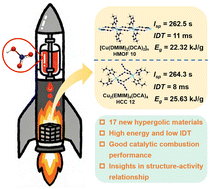
Imidazoles are widely used as metal ligands in solid hypergolic materials, but these compounds generally suffer from low density and insufficient specific impulse. By contrast, dicyandiamide can serve as an effective ligand to enhance the density, specific impulse, and hypergolic performance of such materials. Herein, a series of hypergolic metal–organic frameworks (HMOFs, 1–10) and hypergolic coordination complexes (HCCs, 11–17) were synthesized using N-vinylimidazole and dicyandiamide as ligands. These materials show excellent mechanical insensitivity (impact sensitivity >40 J, friction sensitivity >360 N). Among them, HMOF 10 and HCC 12 exhibit outstanding comprehensive properties, including low ignition delay times (IDTs: 11 and 8 ms), high specific impulse (Isp: 262.5 and 264.3 s), high density (1.520 and 1.409 g cm−3) and high heats of formation (22.32 and 25.63 kJ g−1). The LUMO–HOMO orbital energy gap (ΔEL–H) of these materials is proportional to their IDTs. Moreover, EL–H decreases with increasing metal electronegativity, and the introduction of electron-donating groups into the ligands, as well as multinuclear metal structures, can further reduce EL–H. Compared with HCCs, HMOFs have higher densities and decomposition temperatures, and their Isp and heats of combustion are proportional to the hydrogen content of their ligands. HCC 12 also shows good catalytic combustion performance, significantly increasing the burning rate (3.94 mm s−1) and temperature (>1200.0 K) of AP, while also enhancing the Isp (up to 279.2 s) of composite propellant containing AP and Al powder.
 Please wait while we load your content...


