Acid–Responsive Rhenium(I) NHC Complexes: Pyrazine vs Pyridine

Abstract

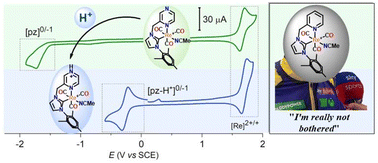
Four rhenium(I) tricarbonyl complexes featuring pyridine- or pyrazine-functionalized N-heterocyclic carbenes were synthesized and fully characterized, including the determination of their molecular structures by single-crystal X-ray diffraction. Electrochemical and spectroelectrochemical measurements were performed. The development of isosteric Re(I) complexes enabled a direct comparison of how Brønsted and Lewis acids influence their electronic properties. Complexes containing the pyridyl core showed no detectable changes in either electrochemical or spectroscopic studies. In contrast, those bearing the pyrazine fragment exhibited significant shifts at both reductive and oxidative potentials, attributable to the extra nitrogen atom in the 1,4-diazine ring, which can interact with Brønsted (and Lewis) acids. In this regard, comparison of alkali salts with Brønsted acids revealed that the presence of the latter induces substantially larger electronic perturbations.
Supplementary files

Article information

Article type
Paper
Submitted
21 Jan 2026
Accepted
19 Feb 2026
First published
23 Feb 2026
This article is Open Access
Creative Commons BY-NC license

Dalton Trans., 2026, Accepted Manuscript

Acid–Responsive Rhenium(I) NHC Complexes: Pyrazine vs Pyridine

P. O. Abate, J. F. Rizo, F. J. Fernández-de-Córdova, A. Ros and O. Rivada Wheelaghan, Dalton Trans., 2026, Accepted Manuscript , DOI: 10.1039/D6DT00158K

This article is licensed under a Creative Commons Attribution-NonCommercial 3.0 Unported Licence. You can use material from this article in other publications, without requesting further permission from the RSC, provided that the correct acknowledgement is given and it is not used for commercial purposes.

To request permission to reproduce material from this article in a commercial publication, please go to the Copyright Clearance Center request page.

If you are an author contributing to an RSC publication, you do not need to request permission provided correct acknowledgement is given.

If you are the author of this article, you do not need to request permission to reproduce figures and diagrams provided correct acknowledgement is given. If you want to reproduce the whole article in a third-party commercial publication (excluding your thesis/dissertation for which permission is not required) please go to the Copyright Clearance Center request page.

Read more about how to correctly acknowledge RSC content.

Social activity

Spotlight

Advertisements