


 PLATFORM UPDATE:

Crystal growth of metal tellurides from a boron–tellurium mixture: MTr2Te4 (M = Sr, Eu; Tr = In, Ga)

Abstract
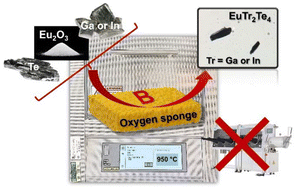
A boron–tellurium mixture was employed as a reactive molten salt to prepare single crystals and polycrystalline powders of three ternary tellurides, MTr2Te4 (M = Sr, Eu; Tr = In, Ga), starting from binary metal oxides. This method represents a simple and efficient synthetic route wherein all reagents can be loaded in air. Single crystal X-ray diffraction was used to characterize the structures of β-EuGa2Te4 (1; space group: Imma), α-EuIn2Te4 (2; Cccm), and SrGa2Te4 (3; I4/mcm). Their structures are similarly comprised of the packing of 1∞[Tr2Te4]2− (Tr = Ga or In) chains separated and charge balanced by the divalent cations (M = Eu or Sr). Distinctive differences in the three structures stem from the arrangements of the divalent cation sites, with two different ordered arrangements found for the Eu cations in 1 and 2, with the former representing a novel polymorph of EuGa2Te4. By contrast, the Sr cations in 3 adopt a fully disordered arrangement (50% occupancy) of the divalent cation sites. Results of total energy calculations show that the α-polymorphs of EuGa2Te4 and EuIn2Te4 are slightly lower in energy than the β-polymorphs. Optical bandgaps were measured using solid-state UV-Vis-NIR techniques, finding that all three exhibit semiconducting properties with direct transitions of 1.10(2) eV, 1.03(2) eV, and 0.93(2) eV, respectively. Electronic structure calculations show that their band gaps stem predominantly from filled Te p-orbitals and empty Ga/In s- and p-orbitals at the edges of their valence and conduction bands, respectively. Hence, a convenient and simple method for the preparation of metal tellurides is demonstrated, thereby unlocking the door to their much broader synthetic exploration.
 Please wait while we load your content...


