


 PLATFORM UPDATE:


Carbon dioxide hydrogenation with cobalt catalysts (Co–N–C) using organosilanes as hydrogen sources

Abstract
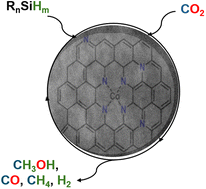
Cobalt–nitrogen–carbon (Co–N–C) catalysts were synthesized from cobalt(II) acetylacetonate and 5-amino-1,10-phenanthroline using high-purity magnesium oxide as a removable support. The resulting materials contain subnanometric cobalt species dispersed within a nitrogen-doped carbon matrix. Structural and chemical analyses were carried out by powder X-ray diffraction, X-ray photoelectron spectroscopy, scanning transmission electron microscopy, inductively coupled plasma mass spectrometry, Raman spectroscopy, and nitrogen adsorption–desorption (BET) measurements. Catalytic performance was evaluated for CO2 reduction using organosilanes (phenylsilane and triethylsilane) as safe hydrogen donors under different temperature and pressure conditions (80 °C, 15 psi and 150 °C, 120 psi). Among the series, the Co-600 catalyst exhibited the highest activity, efficiently converting CO2 to methanol, with concomitant formation of CO and CH4. The addition of promoters (KF/triethylsilane or B(C6F5)3/PhSiH3) enhanced CO2 conversion and altered product distribution, yielding byproducts such as hexaethyldisiloxane or trimethoxyphenylsilane. The results reveal that the pyrolysis temperature and reaction additives play key roles in tuning the catalyst selectivity. This study demonstrates the potential of Co–N–C catalysts as low-cost, stable, and efficient materials for CO2 valorization through catalytic reduction processes employing organosilanes as hydrogen sources.
 Please wait while we load your content...


