


 PLATFORM UPDATE:


Ligand-field symmetry and magneto-optical correlations in a luminescent Dy(iii) single-molecule magnet
 *a
Christian
Pachl,
bc
Sagar
Paul,
d
Benoît
Heinrich,
e
Olaf
Fuhr,
bf
Wolfgang
Wernsdorfer,
ad
Annie K.
Powell,
abc
Karin
Fink
b
and
Mario
Ruben
abg
*a
Christian
Pachl,
bc
Sagar
Paul,
d
Benoît
Heinrich,
e
Olaf
Fuhr,
bf
Wolfgang
Wernsdorfer,
ad
Annie K.
Powell,
abc
Karin
Fink
b
and
Mario
Ruben
abg
Abstract
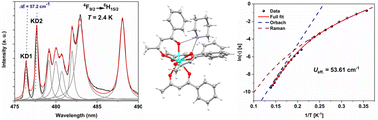
The establishment of ligand field (LF) symmetry around lanthanoid (Ln(III)) centres is of paramount importance to understand factors that govern magnetization relaxation in single-molecule magnets (SMMs). We investigated a luminescent mononuclear Dy(III) compound [Dy(BA)4] (pip) (1), where pip is a piperidinium cation and BA is a benzoylacetonate ligand. The stoichiometric compound exhibits zero-field SMM characteristics; quantum tunnelling of magnetization (QTM) dominates magnetization relaxation. In the diluted version of the compound (1@Y), the QTM is mitigated, and Raman and Orbach processes are involved in the relaxation. The effective energy barrier (Ueff = 53.61 cm−1; HDC = 0 Oe) estimated for magnetization relaxation is comparable with the LF splitting (ΔE = 57.2 cm−1) between the ground and first excited Kramers doublets (KDs) determined from the 4F9/2 → 6H15/2 Dy(III)-based transition recorded at 2.4 K. By analysing the emission spectrum of the isostructural Eu(III) analogue as a spectroscopic probe for site symmetry, the LF symmetry around the Dy(III) centre is assigned as C2v. The close proximity (178 cm−1) of the triplet state of the ligand and the 4F9/2 state of the Dy(III) facilitates back energy transfer, thereby rendering 1 emissive only at cryogenic temperatures. The predictive accuracy of the complete active space spin–orbit configuration interaction (CASOCI) method is benchmarked against the experimental emission profile. Overall, we propose a strategy to assign effective LF symmetry around Dy(III), establish magneto-optical correlations, and provide a comprehensive analysis of the emission process of 1.
- This article is part of the themed collection: Articles behind our 2026 journal covers
 Please wait while we load your content...


