


 PLATFORM UPDATE:


Organic–inorganic hybrid materials with high phase transition temperatures regulated by halogen substitution
 *a
and
Li-Zhuang
Chen
*a
*a
and
Li-Zhuang
Chen
*a
Abstract
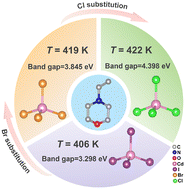
Halogen-substituted morpholine-based organic–inorganic hybrid compounds have attracted attention in phase transition and optoelectronics due to their tunable structural and electronic properties. In this work, a series of crystals, [C6H14NO]2CdI4, [C6H14NO]2CdBr4, and [C6H14NO]2CdCl4, were synthesized and characterized. All exhibit reversible solid–solid phase transitions at 406 K, 419 K, and 422 K, respectively, and semiconducting behavior with tunable band gaps of 3.298–4.398 eV. Supercell and Hirshfeld surface analyses reveal that progressive halogen substitution (I → Br → Cl) strengthens C–H⋯X hydrogen bonds, increases lattice confinement, and raises the rotational potential of organic cations, providing a structural basis for high-temperature phase transitions. This work demonstrates that halogen modulation in the inorganic framework is an effective strategy for designing multifunctional organic–inorganic hybrid materials with controllable thermal and optoelectronic properties.
 Please wait while we load your content...


