


 PLATFORM UPDATE:

Alcohol-mediated self-assembly of mesoporous transition-metal pyrophosphates and phosphates: transformation to metal hydroxides and alkaline OER performance
 *ab
*ab
Abstract
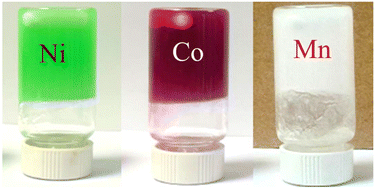
The sol–gel process offers a scalable route to mesoporous materials whose nanoarchitecture can be tuned by controlling the reaction medium. Here, methanol, ethanol, and butanol were used to regulate the reactivity and self-assembly of transition-metal nitrates, pyrophosphoric acid (PPA), and Pluronic® P123. Clear precursor solutions formed mesostructured (M2HxP2O7(NO3)x·yH2O)n–P123 intermediates (M = Mn, Co, Ni) via precipitation or gelation during solvent evaporation. The solution, precipitate, and supernatant fractions were isolated, characterized, and calcined to yield mesoporous products. Solution- and precipitate-derived samples produced amorphous mesoporous M2P2O7 that crystallized at elevated temperatures, whereas the supernatant yielded mesoporous M3(PO4)2. Mesoporous Ni2P2O7 exhibited the highest surface area (410 m2 g−1) and most uniform pore size (5.3 nm), followed by Co2P2O7, while Mn2P2O7 was least favourable, reflecting solvent-dependent sol–gel behaviour. Electrodes fabricated on FTO and graphite and tested in 1 M KOH showed limited stability on FTO but good stability on graphite, except for Mn2P2O7, which underwent Mn(VI) disproportionation. The most stable and OER-active electrodes originated from the Co(II) supernatant. However, all metal phosphate and metal pyrophosphate electrodes transformed into metal hydroxides under alkaline conditions, indicating that the observed electrochemical activity arises from the metal hydroxide phases.
 Please wait while we load your content...


