


 PLATFORM UPDATE:

Preparation of graphdiyne for efficient capacitive extraction of U(vi) from water samples
 *a
*a
Abstract
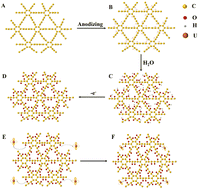
In this work, a one-step hydrothermal condensation process was used to prepare graphdiyne (GDY), which was then used as an electrode material for the capacitive extraction of U(VI) from wastewater. The synthesized GDY exhibited a multilayered lamellar structure, which provided abundant active sites for U(VI) adsorption. Additionally, the average pore diameter of GDY is 3.8 nm, and its specific surface area can attain 60.7 m2·g−1. The electro-adsorption of U(VI) onto the GDY electrode is influenced by applied voltage, competing metal ions, reusability, and pH, and conforms to pseudo-second-order kinetics. At 298.15 K and an applied potential of 1.2 V, the removal efficiency of U(VI) by GDY reached approximately 80.7% within 3 h. After six consecutive cycles, the removal efficiency showed only a 7.9% decrease compared to the initial cycle. Simultaneously, the removal efficiency of GDY for U(VI) significantly surpassed that of other coexisting metal ions, reaching 57.9%, thereby indicating that GDY exhibited a certain selectivity toward U(VI). Furthermore, the extent of redox reactions in GDY had significant variation depending on the applied voltage and scan rate. These studies suggest that GDY exhibits potential application value in the treatment of uranium-containing wastewater.
 Please wait while we load your content...


