


 PLATFORM UPDATE:

A di-nuclear μ-oxido rhenium(vi) complex: from deep purple to catalytic applications
 a
Peter E.
Hartmann,
a
Ferdinand
Belaj,
a
Antoine
Dupé,
a
A. Daniel
Boese
a
and
Jörg A.
Schachner
*a
a
Peter E.
Hartmann,
a
Ferdinand
Belaj,
a
Antoine
Dupé,
a
A. Daniel
Boese
a
and
Jörg A.
Schachner
*a
Abstract
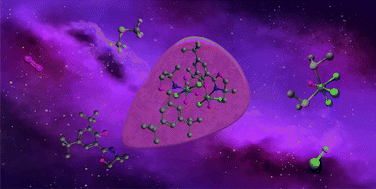
In this manuscript, we report on the formation and isolation of the di-nuclear rhenium(VI) µ-oxido bridged complex {[ReOCl2(L1)]}2(µ-O) (1), which we nick-named “deep purple” due to its intense purple color both in the solid state as well as in solution, and its surprising catalytic activity in oxyanion reduction. Complex 1 was obtained as the unintended product in an attempt to synthesize oxidorhenium(V) complex [ReOCl(L1)2], using the O,N-bidentate phenol-dimethyloxazoline ligand HL1, equipped with two electron-donating tert-butyl groups on the phenol ring. Single crystal X-ray diffraction analysis finally revealed the surprising µ-oxido structure of 1, with two paramagnetic Re(VI) centers and a mixed cis/trans-chlorido arrangement on the two Re centers. Via a targeted synthesis in cyclohexane at 60 °C under ambient conditions, high yields of over 90% of 1 were obtained. To explain the source of the highly stereoselective formation of 1, its formation was examined by DFT calculations at the B3LYP-D3BJ/dhf-TZVPP@B3LYP-D3BJ/dhf-SVP level of theory, with solvent effects included via the COSMO model. In contrast to isoelectronic µ-oxido bridged Mo(V) complexes, 1 proved to be highly active in catalytic oxyanion reduction, namely perchlorate and nitrate reduction. With a catalyst loading of 5 mol% of 1, a conversion of 90% was observed for perchlorate. These findings highlight that in rhenium chemistry, µ-oxido bridged complexes like 1 still show promising catalyst activities for oxyanion reduction and potentially also other redox transformations.
 Please wait while we load your content...


