


 PLATFORM UPDATE:

On the nature and feasibility of unsupported Au⋯Pd metallophilic interactions: a correlated computational study

Abstract
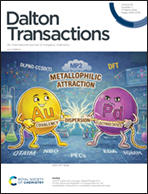
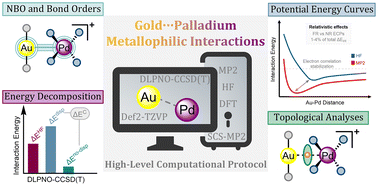
Unsupported Au⋯Pd interactions have not yet been experimentally confirmed, leaving their existence and fundamental nature an open question. Herein, we present a comprehensive multifaceted computational study to grasp their nature and feasibility, using simplified models of typical Au(I)/Au(III) and Pd(II) complexes. Geometry optimizations and interaction energy calculations were carried out at both the DFT and post-Hartree–Fock levels of theory, including MP2, SCS-MP2 and DLPNO-CCSD(T) methods. Potential energy curves computed at the MP2 and RHF levels of theory with different relativistic ECPs allowed us to disentangle the effects of electron correlation and relativistic contributions. In-depth topological analyses based on MP2 and DLPNO-CCSD(T) electron densities were conducted to gain deeper insight into the bonding character. Additionally, we also propose a decomposition scheme to isolate the metal–metal contribution to the total interaction energy; a term whose true nature, repulsive or attractive, remains debatable. This computational protocol, together with the reduced size of the simplified models, provides a consistent and reliable framework for the high-accuracy characterization of metallophilic interactions. Remarkably, the computed Au⋯Pd interaction energy values are stronger than anticipated (10–35 kJ mol−1), with a predominantly ionic and dispersive, closed-shell character and a minor covalent contribution. In these systems, medium-to-strong metal–hydrogen interactions are also present, coexisting and competing with the metallophilic contacts to influence the overall stabilization. Collectively, our results point to the potential existence of related compounds featuring unsupported Au⋯Pd contacts in suitably designed systems, where substantial electrostatic forces further stabilize the models.
- This article is part of the themed collection: Articles behind our 2026 journal covers
 Please wait while we load your content...


