


 PLATFORM UPDATE:

Automated bond valence sum analysis for crystallographic database quality assessment: a systematic study of rock salt oxides, halides, and chalcogenides

Abstract
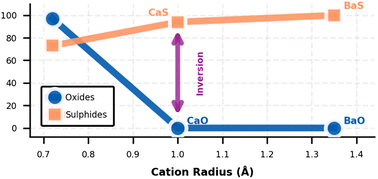
Crystallographic databases are vital for research and increasingly serve as training data for machine learning in materials discovery, yet systematic quality assessment at database scale remains absent. Bond valence sum (BVS) analysis – testing whether calculated bond valences match expected oxidation states – provides one automated quality metric, but has not been systematically applied to quantify validation rates, characterise failure modes, or identify parameter inadequacies. Eir is an automated Python tool for high-throughput BVS analysis, applied here to 840 rock salt structures from the Inorganic Crystal Structure Database. Of 613 assessable structures, 50.8% validated under ambient data collection conditions, with systematic examination leaving no unexplained outliers. ‘Failed’ structures stratify into six categories (Types 1–6): Type 1, systematic parameter inadequacy (107 structures, 21.3%); Type 2, missing BVS parameters (154 structures, excluded from validation); Types 3–5, methodological limitations from diffraction-averaged geometries (65 structures, 12.9%); and Type 6, database quality issues (12 structures, 2.4%). Three main findings emerged: (1) alkaline earth oxides exhibit systematic parameter inadequacy (CaO, SrO, BaO: 100% failure, <1.5% variance); (2) oxide–chalcogenide validation inversion demonstrates anion-specific parameter quality; (3) multi-phase refinement contamination shows structures passing peer review may prove inappropriate as computational references. The open-source tool provides validated infrastructure for maintaining database integrity as crystallographic repositories serve AI-driven materials discovery at unprecedented scale.
- This article is part of the themed collection: Dalton Transactions: HOT Articles
 Please wait while we load your content...


