


 PLATFORM UPDATE:


Eu3+ doped Y3+ dipicolinate crystals: differences in the luminescence spectra and concentration quenching of Eu3+ luminescence

Abstract
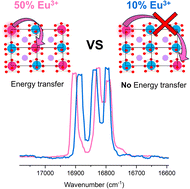
Materials doped with lanthanide(III) ions are used in solar cells, LEDs, bioimaging etc. However, we still need to understand the effect of concentration on the luminescence properties. Here, the Na(Gua)2[Ln(DPA)3]·6H2O crystal system is explored. Luminescent Eu3+ ions were doped into non-luminescent Na(Gua)2[Y(DPA)3]·6H2O crystals. The crystal structures were determined using single-crystal X-ray diffraction and the doping percentage was determined through ICP-based elemental analysis. The luminescence properties were indeed found to change as a function of the doping percentage. In the emission spectra, the positions of the lines in the 5D0 → 7F1 and 5D0 → 7F4 bands were observed to change as a function of Eu3+ concentration. The spectra of the pure Eu3+ sample had the largest splitting, while the identical spectra for 30%, 20%, and 10% doping with Eu3+ had the smallest splitting. No change was observed in the luminescence lifetime for the samples with 10–30% Eu3+ doping. Above 30% doping a decrease in luminescence lifetime was observed with increased doping. Above 30% doping, the distance between the Eu3+ ions became so small that concentration dependent quenching was observed, which allowed for the rate constant of concentration dependent quenching to be determined. We conclude that the concentration dependent quenching is orders of magnitude less efficient than quenching by e.g. water.
 Please wait while we load your content...


