


 PLATFORM UPDATE:

Dinuclear copper(i) halide complexes containing unsymmetric diphosphine: structure, photophysical and photocatalytic hydrogen production properties

Abstract
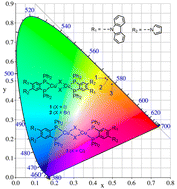
Highly emissive Cu(I) halide complexes with short decay lifetimes (several μs scale) have attracted attention. Here, three dinuclear four-coordinate Cu(I) halide complexes containing unsymmetric diphosphine [Cu2X2(L1)2] (L1 = 9-(4,5-bis(diphenylphosphino)-2-(1H-pyrrol-1-yl)phenyl)-9H-carbazole, X = I (1), Br (2), Cl (3)) were synthesized, and their structures, photophysical and photocatalytic hydrogen production properties were characterized. In these complexes, two copper(I) centers are bridged by two halogen ligands to form a dinuclear structure with a four membered Cu2X2 ring. Complex 3 has a mirror symmetric form, whereas complexes 1 and 2 have a centrosymmetric form. At ambient temperature, complexes 1–3 in the powder state emit intense greenish yellow to yellow delayed fluorescence (λem = 573–590 nm, τ = 1.2–1.5 μs, Φ = 9.62%–19.58%). The introduction of 1-pyrrolyl and 9-carbazolyl substituents into the diphosphine resulted in the red-shifted emission and shorter decay lifetime of the complexes. The very short decay lifetime (1.2–1.5 μs) will prevent a roll-off of efficiency with increasing current density in OLED devices. The emissions of the complexes 1–3 originated from (metal + halide)-to-ligand and intra-ligand charge transfer. Under visible-light irradiation, complexes 1–3 displayed photocatalytic H2 evolution activity. Complex 3 showed the highest hydrogen production rate of 156.3 μmol g−1 h−1.
 Please wait while we load your content...


