


Phenoxybis(imine) complexes of vanadium: structure, ethylene polymerization, and ring opening polymerization of ε-caprolactone

Abstract
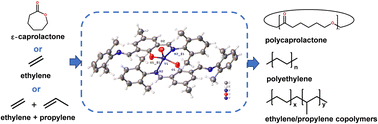
A number of phenoxybis(imine) compounds (p-RLnH) (R = Me, t-Bu) derived from 2,6-diformyl-4-methylphenol or 2,6-diformyl-4-t-butylphenol and substituted anilines bearing 2,6-dimethyl (p-RL1H), 2,6-diisopropyl (p-RL2H), 2-tert-butyl (p-RL3H), 2-iodo (p-RL4H), 2,3,4,5,6-pentafluoro (p-RL5H), 2-trifluoromethyl (p-RL6H) and 2-iodo,4-fluoro (p-RL7H) substituents were prepared and subsequently reacted with [VO(OR′)3] (R′ = Et, i-Pr) in the presence of Me3Al. The molecular structures of the bis(chelate) vanadyl products [VO(Ln)2] 1 (n = 1, R = Me), 3 (n = 2, R = Me), 11 (n = 6, R = Me), two solvatomorphs of 12 (n = 6, R = t-Bu) and 14 (n = 7, R = t-Bu) in which the metal adopts a square pyramidal geometry, have been determined. Molecular structures are also reported for the bis(imino)phenol compounds p-MeL3H and p-MeL5H. The complexes 1–14 (n = 1 to 7) have been screened for their ability to act as catalysts for the ring opening polymerization (ROP) of ε-caprolactone. ROP results revealed that the systems could achieve high conversions, particularly under air, at 130 °C in toluene or as melts. Kinetics studies indicate complexes 6 and 12 are the most efficient catalysts, whilst the products formed are cyclic (minor) and linear polymers (major) as identified by MALDI-ToF mass spectra. Complexes 1 and 2 have been screened as pre-catalysts for the polymerization of ethylene in the presence of EADC (ethylaluminium dichloride) and ETA (ethyl trichloroacetate) at various temperatures and for the co-polymerization of ethylene with propylene. In the case of ethylene polymerization, the thermal stability was improved compared with tetra-dentate quinolin-8-ylimino vanadyl complexes previously evaluated. In ethylene/propylene copolymerization, complexes 1 and 2 produced ‘ethylene/propylene copolymer’ with a higher propylene content than the tetra-dentate quinolin-8-ylimino vanadyl complexes.
 Please wait while we load your content...


