


 PLATFORM UPDATE:


Crystallographic evidence of a trinuclear (salen)manganese(iv/iii/iv)–μ-oxo formed during catalytic C(sp3)–H oxidation reactions

Abstract
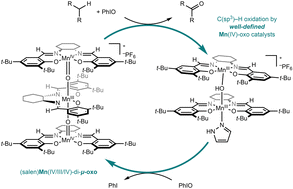
The formation of manganese–oxo catalysts involved in C(sp3)–H bond oxidation was explored in the targeted synthesis of (salen/salophen)manganese complexes that varied axial ligand identity and varied oxidation state of the manganese center. Isolated compounds included dinuclear (salen/salophen)manganese(III)–μ-hydroxo and trinuclear (salen)manganese(IV/III/IV)–μ-oxo, the latter of which formed by oxidation with catalytically relevant oxidant iodosylbenzene. The X-ray structure of trinuclear complex (salen)manganese(IV/III/IV)–μ-oxo indicated a Mn(IV)–O–Mn(III)–O–Mn(IV) motif, with nearly linear Mn–O–Mn angles of 166.19(12)° and 172.47(15)°, Mn(IV)–O bond lengths of 1.948(2) and 1.998(2) Å, and Mn(III)–O bond lengths of 2.102(2) and 2.118(2) Å. All well-defined (salen/salophen)manganese hydroxo and oxo compounds served as precatalysts for oxidation of C(sp3)–H substrates 9,10-dihydroanthracene (>99% conversion), fluorene (52–70% conversion), and phenylcyclohexane (with lower 18–23% conversion), albeit with lower rate of activity for the isolated trinuclear μ-oxo compound, allowing its assignment as an off-cycle catalyst aggregate. These data supported the proposal of a manganese(III/V) cycle for C(sp3)–H oxidation, which involved monomerization of the dinuclear (salen)manganese(III)-μ-hydroxo catalyst prior to rate-determining C(sp3)–H activation.
- This article is part of the themed collection: Celebrating International Women’s Day 2026: Women in Inorganic Chemistry
 Please wait while we load your content...


