


 PLATFORM UPDATE:

Magneto-structural and theoretical insights into Ni2Dy2 butterfly single-molecule magnets with diverse anionic co-ligands

Abstract
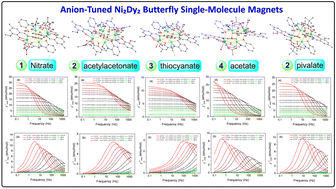
Five defective dicubane Ni2Dy2 complexes with the general formula [Ni2Dy2(L)4X2(solvent)n], where (X = NO3− (1), acetylacetonate (2), NCS– (3), OAc− (4), and pivalate (5)), were synthesized and structurally characterized to investigate how co-ligand variation influences magnetic exchange interactions, anisotropy, and relaxation dynamics. Single-crystal X-ray diffraction reveals that the DyIII ions adopt highly axial coordination environments ranging from distorted square-antiprismatic and triangular dodecahedral geometries in complexes 1–4 to a near pentagonal-bipyramidal geometry in 5. All complexes exhibit zero-field single-molecule magnet behavior, consistent with strong axial ligand fields. CASSCF calculations confirm that the shortest Dy–O(phenoxide) bonds govern the orientation of the magnetic easy axes, aligning toward terminal phenoxide donors. Broken-symmetry DFT calculations indicate uniformly positive Dy–Ni coupling constants, in line with typical ferromagnetic 3d–4f interactions, while the Ni–Ni coupling strength and sign are dictated by the Ni–O–Ni bridging angle, with a crossover between ferro- and antiferromagnetic regimes near 99°. This structural sensitivity rationalizes the comparatively weaker relaxation dynamics observed in complex 3, which features a larger Ni–O–Ni bridging angle accompanied by antiferromagnetic Ni–Ni interactions. These combined experimental and theoretical results establish robust structure–property correlations that provide a rational strategy for tuning anisotropy and exchange topology in Ni–Ln butterfly clusters to advance 3d–4f single-molecule magnet design.
 Please wait while we load your content...


