


 PLATFORM UPDATE:


Gold(i) alkoxide and thiolate complexes as potential atomic layer deposition precursors
 a
and
David J. H.
Emslie
*a
a
and
David J. H.
Emslie
*a
Abstract
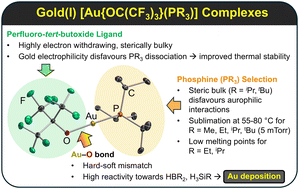
Reactions of AuCl(PR3) with NaOC(CF3)3 in the presence of 1 equiv. of Ag[BF4] or Ag[PF6] afforded the gold(I) alkoxide complexes [(Au{OC(CF3)3}{PR3})n] (R = Me (1), Et (2), iPr (3) and tBu (4)). In our hands, analogous reactions using NaOtBu (for R = iPr) did not yield a thermally robust product. However, the thiolate complexes [{Au(StBu)(PR3)}n] (R = Me (5) and iPr (6)) were accessed by reaction of [{Au(StBu)}n] with PR3. Compound 1 is a trimer featuring linear Au{OC(CF3)3}(PMe3) units connected through unsupported aurophilic interactions, whereas more sterically hindered 3 and 4 are monomers in the solid state. Compound 5 is a dimer connected via an aurophilic interaction, while 6 is a monomer. In solution, 1 and 3 reacted almost instantly with HBpin or H3SiPh to afford metallic gold and volatile byproducts (free PR3 and H2 accompanied by {(F3C)3CO}Bpin or a mixture of {(F3C)3CO}SiH2Ph and {(F3C)3CO}2SiHPh). By contrast, analogous reactions with thiolate complex 5 required over 24 hours to reach completion. Complexes 1–4 melted at 105–106, 19–21, 59–61 and 181–183 °C, respectively, and sublimed cleanly between 50 and 80 °C at 5 mTorr. By contrast, 5–6 decomposed (completely or partially) during attempted sublimation at 5 mTorr; in the case of 5, decomposition was shown to occur via phosphine dissociation to re-form [{Au(StBu)}n]. Of the complexes in this work, 3 offers the best combination of thermal stability and volatility, and the relatively low melting point is attractive. However, 3 was ∼4% decomposed after 72 h at 85 °C, and ∼10% decomposed after 96 h at 100 °C, forming soluble [Au(PiPr3)2][H{OC(CF3)3}2] (7), gold metal, and other insoluble product(s). Preliminary ALD reactor experiments using 3 (with a delivery temperature of 85 °C) and HBpin showed gold deposition at 124 °C, and no deposition was observed at this temperature using 3 without HBpin.
 Please wait while we load your content...


