


 PLATFORM UPDATE:


Modeling and simulation approaches for solid-state battery interfaces: challenges, insights, and future perspectives

Abstract
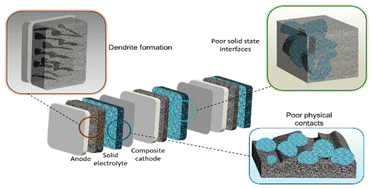
Solid-state batteries (SSBs) are crucial for next-generation energy storage because of their higher energy density, better safety, and longer cycling stability compared with traditional liquid-electrolyte batteries. However, their real-world application is limited by issues at the interface, such as dendrite formation, mechanical instability, and low ionic conductivity. Modeling and simulation techniques at the atomic and mesoscale levels have become key tools for understanding, predicting, and solving these issues. This review offers an overview of recent theoretical methods related to SSB interfaces, behavior, and performance. This review also covers the structural, kinetic, and electrochemical characteristics of the LiPON solid electrolyte using computational and theoretical approaches. Interfacial interactions, defect formation energetics, and the breakdown products controlling the electrochemical stability of LiPON against lithium (Li) metal are examined in this study. LiPON was selected as a model system due to its proven interfacial and electrochemical stability, high ionic conductivity, and wide utilization in thin-film all-solid-state batteries, providing a reliable platform for understanding interface-controlled processes. We conclude with a discussion of the current challenges, limitations of existing methods, and outline promising pathways for accurately modeling and predicting complex solid-state battery interface phenomena.
- This article is part of the themed collection: 2026 Frontier and Perspective articles
 Please wait while we load your content...


