


 PLATFORM UPDATE:


The adsorption features, surface polarity and enantioselectivity of the chiral zeolite-like material cobalt borophosphate

Abstract
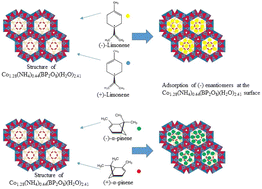
The adsorption properties of a zeolite-like material, Co1.28(NH4)0.44(BP2O8)(H2O)2.41 (Z-CoBP), were systematically investigated. Z-CoBP crystallizes in a chiral space group (P6522 or P6122) and forms chiral conglomerates. In this study, both the polarity and enantioselectivity of Z-CoBP were evaluated. The results revealed high surface polarity, with specific interactions playing a dominant role in the adsorption energy of polar molecules. Alcohol adsorption occurred exclusively through the hydroxyl group, while for n-alkanes, smaller molecules such as n-pentane exhibited higher adsorption enthalpy and greater entropy loss compared to larger n-alkanes, due to partial adsorption of the latter outside the material's micropores (6–7 Å). The chirality of Z-CoBP crystals arises from spontaneous symmetry breaking via Viedma ripening, as evidenced by nearly equal probabilities of left- and right-handed crystal formation, confirmed by circular dichroism (CD) spectroscopy. The studied sample demonstrated enantioselectivity for α-pinene and limonene enantiomers, with maximum enantioselectivity coefficients of 1.45 for limonene and 1.19 for α-pinene. For [CD(−)208] samples, R-(+)-limonene adsorption was preferential, and vice versa. Isosteric heats of adsorption (Qst) decreased with increasing adsorption, with a more pronounced decrease observed for limonene, reaching the heat of condensation at lower adsorption values. This indicates a more stable adsorption layer for limonene, accounting for its higher enantioselectivity. Upon thermal treatment to remove water and ammonia from the crystal lattice, enantioselectivity was lost for both enantiomer pairs, suggesting that the removal of these species disrupts the helical pore structure. These findings establish Z-CoBP as a highly polar adsorbent capable of separating enantiomers.
 Please wait while we load your content...


