


 PLATFORM UPDATE:

Diverse structures and emission properties of copper(i) iodide complexes based on an oxadiazole-type ligand

Abstract
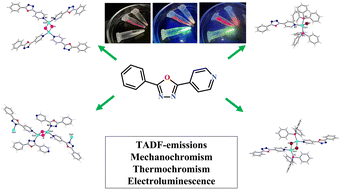
Four new copper(I) iodide complexes with 2-phenyl-5-(4-pyridyl)-1,3,4-oxadiazole (L), namely [Cu2I2L2(PPh3)2]·2CHCl3 (1·2CHCl3), [CuIL(PPh3)2]·MeOH (2), [Cu2I2L4]·MeCN (3), and [CuIL] (4), were synthesized and characterized by IR, TGA, PXRD, single crystal X-ray diffraction and quantum chemical methods. Triphenylphosphine containing complexes 1 and 2 are highly photoluminescent at room temperature in the solid state (λem = 585 and 523 nm for 1 and 2, respectively), while homoleptic complexes show a moderate emission under similar conditions (λem = 546 and 648 nm for 3 and 4, respectively). In addition, the emission color and/or efficiency was altered by thermal and mechanical stimuli, and the responsiveness was dependent on the complex structure. Efficient solution-processed yellow emitting OLEDs were fabricated based on 1 as the dopant. A high external quantum efficiency (EQE) of 23% and a maximum current efficiency (CE) of 56 cd A−1 at a luminance of 1000 cd m−2 were achieved in the obtained device.
 Please wait while we load your content...


