


 PLATFORM UPDATE:


Effect of combining 1-naphthoate and pentafluorobenzoate anions in Eu(iii) compounds on their structure and photoluminescent properties
 ab
Maxim A.
Shmelev,
*a
Andrey V.
Lalov,
b
Julia K.
Voronina,
a
Igor L.
Eremenko
a
ab
Maxim A.
Shmelev,
*a
Andrey V.
Lalov,
b
Julia K.
Voronina,
a
Igor L.
Eremenko
a
Abstract
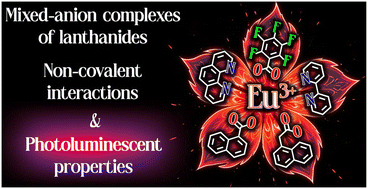
The example of mixed-anion europium complexes containing pentafluorobenzoate (pfb), 1-naphthoate (1-nap) anions, with 1,10-phenanthroline (phen) or 2,2′-bipyridyl (2,2′-bpy) molecules demonstrates that varying the ratios of the starting reagents, as well as the conditions of synthesis and crystallization, allows for targeted control over the composition and structure of the resulting compounds: [Eu2(phen)2(1-nap)4(pfb)2]·2MeCN (1), [Eu2(H2O)2(phen)2(1-nap)2(pfb)4]·2MeCN (2), [Eu2(2,2′-bpy)2(1-nap)2(pfb)4]·2MeCN (3), [Eu2(2,2′-bpy)2(1-nap)3(pfb)3]·2MeCN (4), [Eu2(2,2′-bpy)2(1-nap)2(pfb)4]·2C6H6 (5), [Eu4(phen)4(1-nap)1(pfb)11]n·n[Eu2(phen)2(1-nap)2.7(pfb)3.3] (6), [Eu2(phen)2(pfb)6]n·2nMeCN (7·MeCN), [Eu2(phen)2(pfb)6]n·4nMeOH (7·MeOH). Furthermore, on the example of compound [Eu2(phen)2(1-NAA)2(pfb)4] (8), it was shown that mixed-anionic compounds can be obtained by combining the more flexible 1-naphthaleneacetate (1-NAA) and pfb anions. In compounds 3 and 6, some anion positions are disordered because both 1-nap and pfb anions occupy the same positions in varying ratios. The examples demonstrate that careful optimization of non-covalent interactions enables precise control over the structure and physicochemical properties of these coordination compounds, resulting in improved luminescent performance. The obtained compounds were characterized by single-crystal and powder X-ray diffraction, luminescence spectroscopy, infrared (IR) spectroscopy, and elemental (CHN) analysis. The photoluminescent properties were studied for the solid-state samples. Additionally, the density functional theory (DFT) method was employed to model the frontier molecular orbitals of the complexes and analyze their electronic structures.
- This article is part of the themed collection: Celebrating International Women’s Day 2026: Women in Inorganic Chemistry
 Please wait while we load your content...


