


 PLATFORM UPDATE:


Synthesis of carbon-coated FeSe2 nano-microspheres with a stable SEI film as anode materials for high-performance sodium-ion batteries
 †ac
Xiaohui
Huang
*b
†ac
Xiaohui
Huang
*b
Abstract
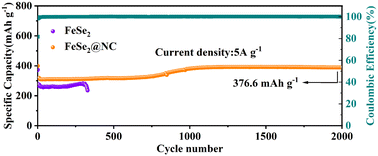
Sodium-ion batteries (SIBs) have recently gained significant interest for grid-scale energy storage due to sodium's abundance and their low cost, environmental friendliness, and similarities to lithium-ion batteries (LIBs). Nevertheless, the widespread application of SIBs remains severely constrained by their inadequate rate capability and suboptimal cycling durability—fundamental challenges stemming from the larger ionic radius of Na+. This inherent characteristic not only compromises the structural integrity of electrode materials but also leads to significantly sluggish reaction kinetics, thereby hindering efficient energy conversion processes. Herein, N-doped carbon-coated FeSe2 (FeSe2@NC) nano-microspheres have been synthesized via solvothermal and selenization techniques. The engineered anode material demonstrates exceptional cycling durability (376.6 mAh g−1 retention at 5 A g−1 over 2000 cycles) coupled with practical viability in a full-cell configuration (322.0 mAh g−1 at 2 A g−1 when paired with a Na3V2(PO4)3 cathode), collectively demonstrating considerable promise for large-scale energy storage solutions. In-depth investigation employing ex situ X-ray photoelectron spectroscopy combined with electrochemical measurements demonstrates that the enhanced sodium storage capability of FeSe2 is attributed to the formation of a stable solid electrolyte interphase, improved Na+ diffusion kinetics, and increased electronic conductivity. Distinct from conventional FeSe2/C composites, the unique nano-microsphere architecture developed herein establishes a more coherent conductive network with uniform carbon encapsulation, enabling efficient volume buffering and enhanced interfacial kinetics, highlighting the morphological merit of our synthesis route for advanced FeSe2 anodes.
 Please wait while we load your content...


