


 PLATFORM UPDATE:


Enhanced pseudocapacitive performance of a Pb-based MOF/FCNT composite for high-stability supercapacitor applications: a step ahead towards energy storage
 †a
Ahmad
Husain,
†bc
Sara A.
Alqarni,
d
Mohd
Zeeshan,
a
Xiang
Li
f
and
M.
Shahid
*a
†a
Ahmad
Husain,
†bc
Sara A.
Alqarni,
d
Mohd
Zeeshan,
a
Xiang
Li
f
and
M.
Shahid
*a
Abstract
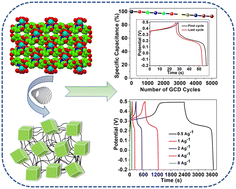
As society moves towards a low-carbon future, the global emphasis on efficient and sustainable energy storage platforms increases and has intensified the search for advanced electrode materials that offer high capacitance, fast charge–discharge capability, and long-term cycling stability. However, most conventional materials suffer from limited electrical conductivity, poor rate performance, or structural degradation over extended cycling. To address these limitations, a novel composite electrode material based on a Pb-based MOF (YK-2) and functionalized carbon nanotubes (FCNTs) was developed and systematically studied. A series of composites, YK-2@FCNT(5), YK-2@FCNT(10), and YK-2@FCNT(15), were successfully synthesized and thoroughly investigated by cyclic voltammetry (CV), galvanostatic charge–discharge (GCD), and electrochemical impedance spectroscopy (EIS) in a three-electrode system. Among them, YK-2@FCNT(10) demonstrated the highest specific capacitance of 913.57 F g−1 at 0.5 A g−1, significantly outperforming the pristine YK-2 electrode. EIS analysis revealed a marked reduction in both solution and charge transfer resistance due to the incorporation of FCNTs, enhancing conductivity and ion diffusion. Dunn's method further confirmed a mixed charge storage mechanism with a b-value of 0.747, where the proportion of capacitive contribution rose significantly from 32.02% to 65.33% as the scan rate increased from 5 to 80 mV s−1. Additionally, YK-2@FCNT(10) retained 92.87% of its initial capacitance even after 5000 consecutive charge–discharge cycles at 10 A g−1, indicating excellent long-term electrochemical stability. Furthermore, a symmetrical supercapacitor device assembled using YK-2@FCNT(10) electrodes delivered a high specific capacitance of 216.9 F g−1 at 0.5 A g−1 and maintained an excellent cycling stability of 86.67% over 5000 cycles. The device also achieved a remarkable energy density of 30.12 Wh kg−1 and a maximum power density of 4998.69 W kg−1, confirming its strong potential for practical high-performance energy storage applications.
 Please wait while we load your content...


