


 PLATFORM UPDATE:


Photoactive Fe(iii) pyclen complexes for light-driven aerobic oxidation of p-xylene
 *c
Mario Italo
Trioni,
c
Dominika
Zakutna,
d
Luka
Đorđević,
b
Andrea
Sartorel
*b
and
Alessandro
Caselli
*ac
*c
Mario Italo
Trioni,
c
Dominika
Zakutna,
d
Luka
Đorđević,
b
Andrea
Sartorel
*b
and
Alessandro
Caselli
*ac
Abstract
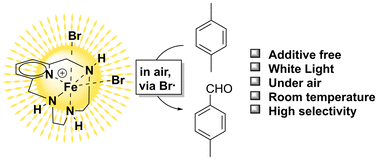
Iron complexes have drawn attention for decades as biomimetic models of enzyme active sites that promote oxidative transformations. Many reports indeed deal with catalytic systems where iron complexes catalyze the oxidation of organic compounds exploiting chemical oxidants, including dioxygen, through thermal activation. Conversely, reports where the photochemical activation of iron complexes is proven are less frequent. In this work, we describe the photochemical activation of iron(III) pyclen complexes, [Fe(III)(X)2pyclen]X (pyclen = 3,6,9-triaza-1(2,6)-pyridinacyclodecaphane; X = Cl, Br, OTf, 1a–c; OTf = triflate, CF3SO3−), and their application to the aerobic oxidation of p-xylene under visible light (up to 415 nm). Complexes 1a–c have been synthesized and characterized, combining structural analysis, Mössbauer spectroscopy, and magnetization. Notably, spectroscopic UV-Vis analyses combined with DFT and TD-DFT calculations show that they have extended absorption up to the visible region attributed to (pyclen/X) ligand-to-metal transitions and that the absorption of light may induce a homolytic cleavage of the Fe–X bond. The nature of X impacts the photochemical activity of the iron complexes towards the oxidation of p-xylene under visible light, with 1b (X = Br) leading to the privileged formation of p-tolualdehyde, while 1a (X = Cl) and 1c (X = OTf) are almost inactive. The reactivity of 1b is rationalized by the photochemical generation of bromine radicals (Br˙) as the active species operating through a hydrogen atom transfer (HAT) reaction towards p-xylene, as supported by the Bond Dissociation Free Energies (BDFEs) of H–Br (BDFE = 87 kcal mol−1) and the C–H bond in p-xylene (BDFE = 80 kcal mol−1). Kinetic and EPR evidence supports a radical autooxidation pathway. This work will guide new studies on the photochemical reactivity of iron complexes towards light-driven, sustainable organic oxidation processes.
- This article is part of the themed collection: Dalton Transactions: HOT Articles
 Please wait while we load your content...


