


 PLATFORM UPDATE:


Novel ruthenium(ii) hexachloromacrobicyclic complexes and their first polyaromatic-terminated diaminoclathrochelate derivative: preparation, structure, redox and adsorption characteristics, and electrocatalytic activity in the hydrogen evolution reaction
 *a
Alexander S.
Chuprin,
b
Danila O.
Mosov,
b
Anna V.
Vologzhanina,
b
Pavel V.
Dorovatovskii,
c
Yulia H.
Budnikova,
d
Vera V.
Khrizanforova,
d
Alexey G.
Dedov,
ae
Sergey Yu.
Kottsov,
a
Maria A.
Teplonogova
a
and
Vladimir K.
Ivanov
a
*a
Alexander S.
Chuprin,
b
Danila O.
Mosov,
b
Anna V.
Vologzhanina,
b
Pavel V.
Dorovatovskii,
c
Yulia H.
Budnikova,
d
Vera V.
Khrizanforova,
d
Alexey G.
Dedov,
ae
Sergey Yu.
Kottsov,
a
Maria A.
Teplonogova
a
and
Vladimir K.
Ivanov
a
Abstract
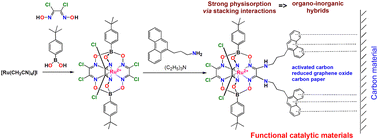
A series of novel diboron-capped ruthenium(II) hexachloroclathrochelates were prepared via the template condensation of three molecules of dichloroglyoxime, as a chelating ligand synthon, with various aromatic boronic acids, as Lewis-acidic capping agents, on a ruthenium(II) ion as a matrix. The use of two equivalents of para-tolylboronic acid in the presence of the cyclooctadiene–acetonitrile ruthenium(II) complex with a tetrafluoroborate counter ion unexpectedly afforded an unique macrobicyclic product with two non-equivalent boron-based apical fragments. Reactive diarylboron-capped ruthenium(II) cage complexes with equivalent cross-linking groups were prepared in moderate yields starting from the acetonitrile ruthenium(II) complex with iodine counter anions. The same initial compound was used for preparation of the chemically robust tert-butylphenylboron-capped ruthenium(II) hexachloroclathrochelate. Its postsynthetic ribbed functionalization with a phenanthrenyl-containing primary amine, as a functionalizing N-nucleophilic agent, afforded the target diphenanthrenyl-terminated ruthenium(II) diaminoclathrochelate. The obtained novel cage 4d-metallocomplexes were characterized using elemental analysis, HR MALDI-TOF mass spectrometry, 1H and 13C{1H} NMR spectroscopy, UV-vis spectroscopy, and single-crystal X-ray diffraction analysis. Their 3D-shaped ruthenium(II)-centered molecules possess intermediate trigonal prismatic–trigonal antiprismatic geometries; their Ru–N distances are relatively short (approximately 2.0 Å). High physisorption of the designed diphenanthrenyl-terminated ruthenium(II) clathrochelate on the surfaces of activated carbon, reduced graphene oxide and carbon paper was found using UV-vis spectrophotometry. The redox characteristics of the prepared complexes and their electrocatalytic activities in the hydrogen evolution reaction (HER) were studied in homogeneous dichloromethane solutions using CV and DPV techniques. Electrochemically generated ruthenium(I)-centered cage complexes are the most probable catalytically active intermediates in this clathrochelate-electrocatalyzed redox reaction. Testing their HER electrocatalytic activity in homogeneous solutions after the addition of H+ ions allowed one to observe the corresponding catalytic waves. In the case of an immobilized ruthenium-based clathrochelate electrocatalyst for the HER, the consumption of this platinum group metal is very low due to the formation of monolayers on the surface of the cathode materials.
 Please wait while we load your content...


