


Boosting oxygen evolution reaction performance via hydrothermally synthesized 4A zeolite-supported Ni catalysts: structure–activity relationship investigation
 *ab
*ab
Abstract
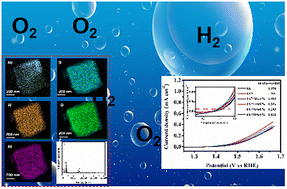
The development of efficient and stable electrocatalysts for the oxygen evolution reaction (OER) is crucial for renewable energy conversion and storage systems. In this study, a series of 4A zeolite-supported Ni (4A/xNi, x = 20, 40, 60, 80 wt%) materials were synthesized via a facile hydrothermal method. The physicochemical properties of the 4A/xNi materials were thoroughly characterized using powder X-ray diffraction (PXRD), transmission electron microscopy (TEM), Fourier transform infrared spectroscopy (FTIR), Brunauer–Emmett–Teller method (BET), X-ray photoelectron spectroscopy (XPS), scanning electron microscopy (SEM), energy dispersive X-ray spectroscopy (EDS), inductively coupled plasma analysis (ICP), and electrochemical tests. The specific surface area of the 4A/80 wt% Ni product was approximately 25 times greater than that of the pristine 4A zeolite. The electrochemical performance of these materials was evaluated using linear sweep voltammetry (LSV). The 4A/60 wt% Ni sample exhibited superior catalytic activity, with low onset potential (1.389 V vs. RHE), low Tafel slope (19 mV dec−1), and low ohmic resistance (157 Ω) compared to the 4A zeolite. Moreover, the largest capacitance density (Cdl) of 98.3 μF cm−2 was recorded for 4A/60 wt% Ni, indicating its high electrochemical active surface area. These results demonstrate that the as-prepared 4A/xNi (x = 20, 40, 60, 80 wt%) materials are promising electrodes for OER applications, showcasing their potential as efficient and durable catalysts for electrochemical water splitting.
 Please wait while we load your content...


