


 PLATFORM UPDATE:


A comprehensive review of the spodium bond as a new crystal engineering motif in Zn/Cd complexes: challenges and future perspectives

Abstract
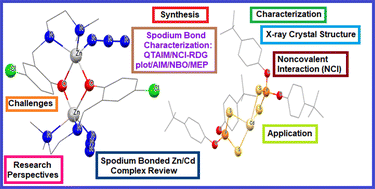
Currently, noncovalent interactions (NCIs), σ/π holes, and spodium bonds (SpBs) are intriguing areas of research in coordination chemistry. Thus, this branch of chemistry offers valuable opportunities for exploration. Still, challenges remain in recognizing the functions of metal complexes in NCI and SpBs. Over the last few years (2019–2025), substantial research has emerged on the SpB features of Zn/Cd complexes with X donor ligands (X = N/O/S/Cl) that go beyond Zn⋯N/Zn⋯O and explore the uncommon Zn⋯Cl and Cd⋯S spodium bonds. This review presents a fresh perspective on the synthesis, characterization, supramolecular synthons, and applications of SpB-containing Zn/Cd complexes. It primarily covers Zn/Cd metal complexes for which X-ray structures are available through CSD searches. This review examines how SpBs differ from other NCIs and identifies weaknesses in the characterization of SpB features. Characterizations covered by Hirshfeld surfaces, QTAIM/NCI plots, RDG, NBO, AIM, BCP, and MEP investigations are described. Meanwhile, the limitations of SpB characterization and DFT-level selection are discussed. This review reveals the limited applicability of HS and QTAIM/NCI plots, which are insufficient for quantum data, and the significance of SpB in biological fields. It discusses the challenges and future perspectives. It focuses on refining the complex synthetic methods, highlighting the application of SpB-bonded Zn/Cd complexes in materials science, and describes the promising biological applications of AI and bioinformatics. Therefore, this comprehensive review presents several new ideas for the next generation of researchers who wish to explore the spodium bond concept. It candidly provides valuable insights into the current trends in the coordination chemistry of SpB-containing Zn/Cd complexes.
- This article is part of the themed collection: 2026 Frontier and Perspective articles
 Please wait while we load your content...


