


 PLATFORM UPDATE:


Enhanced electrochemical performance of NiCo–LDH by inner sulfur doping design

Abstract
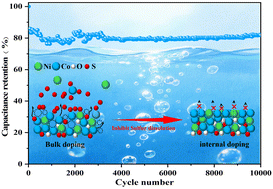
Sulfur doping has been proven to be an effective strategy for improving the rate capability and capacitance of nickel–cobalt layered double hydroxide (NiCo–LDH) supercapacitor electrodes. However, this results in a decrease in cycling stability due to the severe leaching of the S element in alkaline electrolytes. Here, an internal S-doping strategy was adopted to enhance the electrochemical performance of NiCo–LDH while keeping the hydroxide structure stable. The results show that the specific capacitance/capacity of the internal S-doped NiCo–LDH is as high as 1473 F g−1/205 mAh g−1 at 10 mA cm−2, highly surpassing NiCo–LDH (850 F g−1/118 mAh g−1). Compared to that of bulk S-doped NiCo–LDH, the capacity retention rate increased by 38% after 2000 cycles at 50 mA cm−2. The excellent performance is attributed to the S-doping core, which facilitates the rapid electron transfer and exposes redox-active sites, while the NiCo–LDH shell limits the migration of sulfur atoms from the interior to interfacial region, thereby reducing sulfur and metal element dissolution losses. This work provides new insights into the rational structure design of high-performance LDHs with both high energy density and long lifespan.
 Please wait while we load your content...


