


 PLATFORM UPDATE:

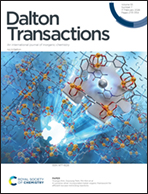
A step-by-step structural transformation of the Ru–Ru bonding unit from a paddle-wheel to edge-sharing bi-octahedra configuration
 a
and
Bin
Liu
*a
a
and
Bin
Liu
*a
Abstract
The structural transformation of the metal–metal bonding dimer induced by external stimuli is of scientific significance in terms of both the synthesis and reactivity of M–M compounds. This study reported the transformation stimulated by Et3N from paddle-wheel Ru2(CH3CO2)4+ with a typical open-shell electronic configuration σ2π4δ2π*2δ* to Ru2(CH3CO2)2(CH3O)2(hfac)2 (2) (hfac = hexafluoroacetylacetonate) via a stable asymmetric intermediate Ru2(CH3CO2)2(CH3O)3(hfac)(CH3OH) (1), and both compounds 1 and 2 exhibit an edge-sharing bi-octahedra (ESBO) characteristic close-shell electronic configuration σ2π2δ2δ*2π*2. The evolution of solution species revealed by temperature- and time-dependent electrospray ionization mass spectrometry (ESI-MS) suggests a step-by-step transformation mechanism, indicating that the Ru2 dimer can adapt to changes in the metal–metal bonding type and oxidation state without undergoing dissociation to monomeric Ru fragments. This is the first study exploring the mechanism of the M–M dimer structural transformation using ESI-MS. The results not only reveal the important reactivity of dimetal carboxylates with ligand exchange but also provide a deep understanding of the conversion mechanism for the type of M–M multiple bond affected by the coordination environment.

 Please wait while we load your content...


