


 PLATFORM UPDATE:


A nickel incorporated triazine-based porous organic polymer for the electrocatalytic methanol oxidation reaction
 *b
and
Papu
Biswas
*a
*b
and
Papu
Biswas
*a
Abstract
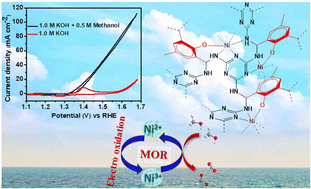
The methanol oxidation reaction (MOR) has been recognized as a promising anode reaction for hydrogen production through electrochemical water splitting. Moreover, the methanol oxidation reaction (MOR) is a key electrode reaction in direct methanol fuel cells (DMFCs). Thus, the development of non-noble metal-based, cost-effective, and efficient electrocatalysts for the methanol oxidation reaction (MOR) is crucial. Herein, a facile polycondensation strategy to fabricate a cost-efficient, triazine-based porous organic polymer (MDF) has been developed by a reaction between 2,6-diformyl-4-methylphenol and melamine. Nickel(II) was incorporated into the polymer by reacting MDF with nickel(II) acetate in dimethyl formamide (DMF). The nickel incorporated catalyst (Ni-MDF) exhibited superior electrocatalytic MOR activity. The MDF and Ni-MDF materials possess high specific surface areas of 500.8 m2 g−1 and 321.86 m2 g−1, respectively, and exceptional thermal stability. The MOR activity reveals the excellent catalytic performance of the Ni-MDF catalyst with a low onset potential of 1.36 V (vs. RHE) and an overpotential of 160 mV (vs. RHE) to achieve 10 mA cm−2 current density. The as-synthesized Ni-MDF catalyst exhibited a Tafel slope of 24.4 mV dec−1 and a current density of 112 mA cm−2 at 1.68 V vs. RHE. The catalyst demonstrates excellent chronoamperometric and chronopotentiometric stability. The faradaic efficiency (FE) of the Ni-MDF-2 catalyst for the production of value added formate at the anode has been evaluated. Moreover, the potential required for the Pt/C||Ni-MDF-2 electrolyzer for hydrogen generation has also been investigated.
- This article is part of the themed collection: Celebrating International Women’s Day 2026: Women in Inorganic Chemistry
 Please wait while we load your content...


