


 PLATFORM UPDATE:


Structural diversity in Zn(ii)/Cu(ii) complexes with salicylic/acetylsalicylic acids and bis(4-pyridylthio)methane: coordination polymers, one organic cocrystal, and one organic salt

Abstract
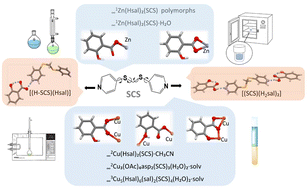
The solid-state chemistry of Zn(II)/Cu(II) salts with salicylic and acetylsalicylic acids and bis(4-pyridylthio)methane (SCS) was explored using various synthetic methods, leading to the isolation of several crystalline materials. These included three polymorphic forms of the one-dimensional coordination polymer 1∞Zn(Hsal)2(SCS) (1m, 1m′ and 1o), as well as the hydrated pseudopolymorph 1∞Zn(Hsal)2(SCS)·H2O (1w). Additionally, a two-dimensional polymer 2∞Cu(Hsal)2(SCS)·CH3CN (2·CH3CN), a three-dimensional salicylate polymer 3∞Cu5(Hsal)6(sal)2(SCS)4(H2O)2 (4·solv), and a two-dimensional aspirinate polymer 2∞Cu3(CH3CO2)4asp2(SCS)3(H2O)2 (3·solv), which also contain a coordinated acetate anion, were obtained. In most systems, the crystallization of the organic salt [(H-SCS)(Hsal)] (5) and the organic cocrystal [(SCS)(H2sal)2] (6) was also observed. All materials were structurally characterized. Stability studies of compound 1m were conducted in water, under acidic conditions and in physiological PBS buffer. Furthermore, the cytotoxicity of the zinc polymorphic polymers was evaluated against non-tumoral human cells (MRC-5) and tumour cell lines (NCI-H460, A549 and MDA-MB231).
 Please wait while we load your content...


