


 PLATFORM UPDATE:


Optical signatures of hydration-controlled hysteretic spin-crossover in single crystals of an Fe(ii) complex

Abstract
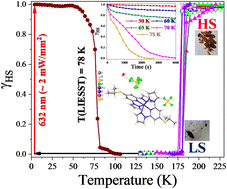
This study presents a comprehensive optical spectroscopic investigation of spin-crossover (SCO) behavior in the Fe(II) complex, [Fe(bppsipr)2](BF4)2 (where bppsipr = 4-(iso-propylsulfanyl)-2,6-bis(pyrazol-1-yl)pyridine), in both hydrated and dehydrated single-crystal forms. High-resolution single-crystal UV-Vis absorption spectroscopy is employed to monitor thermally driven spin-state switching at multiple temperature scan rates, revealing abrupt transitions with variable hysteresis widths. In the hydrated form, hysteresis width narrowed with decreasing scan rate due to reduced kinetic barriers and variation in cooperativity. In contrast, the dehydrated form displayed stronger scan-rate dependence, wider hysteresis, and metastable high-spin (HS) stabilization upon cooling, attributed to increased lattice rigidity and elevated relaxation barriers. Notably, the mutual interplay between elastic and magnetic interactions differed between cooling (HS → LS) and heating (LS → HS) cycles across scan rates. Thermal annealing of the dehydrated crystal restored structural homogeneity, yielding narrower hysteresis and upward-shifted transition temperatures during cooling, without affecting the heating branch—indicating asymmetric energy dissipation dynamics (magnetic vs. elastic) during HS → LS and LS → HS transitions. The hydrated compound also demonstrates efficient photoinduced LS → HS switching (LIESST) at 4 K, with the metastable HS state relaxing sharply near T(LIESST). Time-resolved spectroscopy between 50 and 75 K revealed a two-step HS → LS relaxation mechanism, involving initial stochastic LS nucleation followed by cooperative domain growth. In contrast, no photoresponse is observed in the dehydrated form within the measurement timeframe, likely due to increased  and higher lattice stiffness. Partial LS recovery via reverse-LIESST (830 nm excitation) confirms bistability and domain sensitivity in the hydrated state. To model the photoinduced relaxation behavior, an advanced mechanoelastic framework is applied, integrating thermodynamic, elastic, and local structural factors including hydration-induced pressure and Jahn–Teller distortion. The model successfully reproduced the cooperative HS → LS relaxation kinetics and domain evolution, validating the significance of local pressure fluctuations, lattice inhomogeneities, and angular strain in dictating SCO dynamics. Overall, this work highlights the critical influence of hydration–dehydration, lattice quality, and thermal history on spin-state cooperativity and bistability, offering deep insight into the molecular control of SCO behavior. The integrated experimental–theoretical approach offers valuable insights for designing next-generation photoresponsive SCO materials with tunable switching characteristics.
 Please wait while we load your content...


