


Integration of sequential chemical state transformations in bifunctional copper-based metal–organic frameworks for self-powered photocatalytic reaction systems
 *a
Qi
Qin,
a
*a
Qi
Qin,
a
Abstract
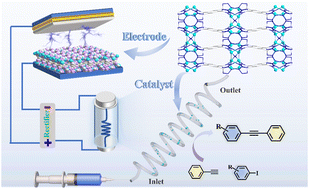
The programming and exploitation of molecular materials with the combination of simultaneous dual/multiple chemical and physical performances is a promising strategy but is only in the initial stages of development. In this work, a controllable and feasible method was proposed, involving the integration of isomorphic copper metal–organic frameworks (Cu-MOFs) with different valence states as dual-function materials to fabricate a selective self-powered photocatalytic continuous-flow system, in which the Cu-MOFs were capable of simultaneously regulating the outputs of triboelectric nanogenerators (TENGs) and photocatalytic properties. A flexible and tailorable CuI-MOF could experience a sequential valence state transformation to construct the topologically equivalent isomorphic CuICuII-MOF and CuII-MOF through a solid–gas oxidation process. Owing to the effect of the different valence states in CuI-MOF, CuICuII-MOF and CuII-MOF, the CuI-MOF-TENG and CuII-MOF-TENG exhibited the highest and lowest output performances, respectively. Furthermore, the CuI-MOF-TENG exhibited outstanding durability and stability to directly power blue LEDs, providing blue-light irradiation to conduct self-powered selective photocatalytic continuous-flow coupling reactions with CuI-MOF, CuICuII-MOF and CuII-MOF as photocatalysts. The results showed that CuI-MOF exhibited well-defined platforms with regular and identical CuI active centers to realize an efficient cooperative effect for improving the photocatalytic efficiency. This work presents a candidate approach to fabricate a bifunctional material to achieve the design targets of multitasking in selective self-powered continuous-flow systems.
 Please wait while we load your content...


