


Biomass-derived hard carbon anodes with enhanced capacity for sodium-ion batteries

Abstract
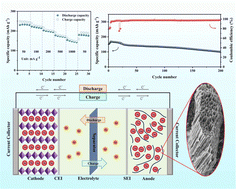
The development of high-performance anode materials remains a key challenge for sodium-ion batteries (SIBs). Among various anode candidates, carbon-based materials have attracted significant attention owing to their low cost, high abundance, and excellent electrical conductivity. However, their practical application is still hindered by several limitations. Herein, we report a simple and effective strategy for synthesizing hard carbon anodes (NLHC) derived from loofah via hydrothermal treatment. The resulting NLHC delivers a high reversible capacity of 334.8 mA h g−1 and an initial coulombic efficiency (ICE) of 71.92%, alongside superior long-term cyclability, retaining 191.3 mA h g−1 after 1000 cycles at 1000 mA g−1. Sodium-storage mechanism analysis reveals an ‘adsorption-intercalation’ mechanism. Full-cell tests further demonstrate a high average voltage of ∼3.3 V, a specific capacity of 233.4 mA h g−1, and an energy density of 218.5 Wh kg−1. The full cell also demonstrates excellent cyclic stability, retaining 65.80% of its capacity after 200 cycles at 500 mA g−1. This work offers valuable insights into the design of high-performance SIB anodes and highlights the potential of biomass-derived carbons for sustainable energy storage applications.
 Please wait while we load your content...


