


 PLATFORM UPDATE:


Mono- and bimetallic homo- and heterodinuclear Pd and Pt complexes bridged by diphosphines: synthesis, characterisation and cytotoxicity

Abstract
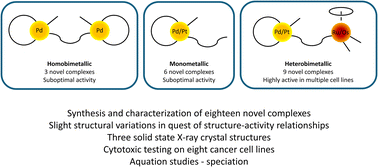
Herein we report a series of monometallic complexes: [(κ2-dppe)MCl(κ1-dppx)](OTf) (where dppe = 1,2-bis(diphenylphosphino)ethane; dppx = 1,4-bis(diphenylphosphino)butane (dppb) (M = Pd (Pd-1) or Pt (Pt-1)), 1,5-bis(diphenylphosphino)pentane (dpppent) (M = Pd (Pd-2) or Pt (Pt-2)), or 1,6-bis(diphenylphosphino)hexane (dpph) (M = Pd (Pd-3) or Pt (Pt-3))). We also report the homobimetallic complexes [((κ2-dppe)PdCl)2(μ-dppx)](2OTf) (dppx = dppb (PdPd-1), dpppent (PdPd-2) or dpph (PdPd-3)). In addition, the Ru(II)-based heterobimetallic complexes [(κ2-dppe)ClM(μ-dppx)RuCl2(η6-p-cym)](OTf) (M = Pd and dppx = dppb (PdRu-1), M = Pd and dppx = dpppent (PdRu-2), M = Pd and dppx = dpph (PdRu-3), M = Pt and dppx = dppb (PtRu-1), M = Pt and dppx = dpppent (PtRu-2), M = Pt and dppx = dpph (PtRu-3), and Os-based heterobimetallic complexes [(κ2-dppe)ClPd(μ-dppx)OsCl2(η6-p-cym)](OTf) (dppx = dppb (PdOs-1), dpppent (PdOs-2) and dpph (PdOs-3)) are also reported. All complexes were fully characterised by spectroscopic means and their stability in DMSO was determined via time-dependent NMR spectroscopy. Aquation studies were performed in a PBS buffer : DMSO solution (90 : 10 v/v) at 37 °C to determine the various entities which could form in biological media and are discussed. The solid-state structures of complexes PdPd-0, PdPd-1 and PdRu-1 were further characterised by single crystal X-ray diffraction analyses and are reported. The cytotoxicity of all complexes was evaluated in vitro against a wide panel of cancer cell lines. While the monometallic and homobimetallic complexes showed sub-optimal activity, the heterobimetallic complexes all displayed good to excellent cytotoxicity. PdRu-1 displayed an IC50 value of 3.43 ± 1.43 µM and a selectivity index of 6.16 on the Ca Ski cell line. The results from this study highlight the increased efficacy of heterobimetallic systems with regards to their monometallic or homobimetallic counterparts for Pd(II) and Pt(II) type complexes.
- This article is part of the themed collection: Celebrating International Women’s Day 2026: Women in Inorganic Chemistry
 Please wait while we load your content...


