


Emission and ESA/GSA thermographic properties of Pr-doped tungstate phosphors under vacuum ultraviolet and visible excitation

Abstract
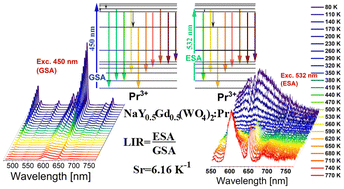
The impact of synchrotron radiation, temperature, and optically active ion concentration on the emission and thermographic properties of Pr3+-doped NaY0.5Gd0.5(WO4)2, NaGd(WO4)2 and NaY(WO4)2 phosphors was investigated. At cryogenic temperature T = 12 K, synchrotron radiation stimulates intense, broad-band O2−–W6+ charge transfer emission within the 350–700 nm spectral region. The VUV-UV excitation processes are characterized by complex effects involving charge transfer phenomena and excitonic transitions. The excitation realized by the ultrashort femtosecond laser pulses was able to recognize and characterize various relaxation dynamics of 3P0/1D2 praseodymium excited states and [WO4]2− luminescence. The effective interionic processes correspond mainly to cross-relaxation channels employing 1D2 praseodymium luminescence levels for all studied tungstate phosphors. Two-band and single-band-ratiometric approaches utilizing thermally coupled 3P0/3P1 levels and GSA/ESA transitions were applied to evaluate the materials under study as potential luminescent thermometers. In particular, the visible emission of praseodymium increased with increasing temperature for the excited state absorption (ESA) process in contrast to ground state absorption (GSA). As a result, effective relative sensitivity reaching above 6% K−1 was determined for the Pr3+-doped solid solution phosphor.
 Please wait while we load your content...


