


 PLATFORM UPDATE:


Ligand-mediated modulation in copper(ii) complexes for four-electron oxygen reduction in neutral medium

Abstract
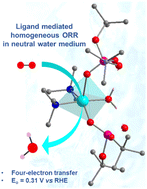
Efficient molecular catalysts for the oxygen reduction reaction (ORR) are essential for advancing sustainable energy technologies. Inspired by copper-based metalloenzymes, this study reports the synthesis and characterization of two copper(II) complexes with di-tert-butyl phosphate (dtbp-H) ligands: [Cu(en)2(enH2)][(dtbp)4]·10H2O (1) and [Cu(tmeda)(dtbp)2(H2O)] (2), where 1,2-ethylene diamine (en) and N,N,N′,N′-tetramethylethylene diamine (tmeda) serve as ancillary nitrogen-donor ligands. Single-crystal X-ray diffraction studies revealed distinct coordination environments, with 1 adopting a square planar geometry and 2 exhibiting a square pyramidal structure with an axially bound water molecule. Electrochemical studies in neutral aqueous medium showed that both complexes undergo dynamic speciation in solution, displaying irreversible redox behaviour associated with multiple coupled electron-transfer and partial copper deposition during operating conditions. The complexes catalyse oxygen reduction through a dynamic equilibrium between solution-phase and surface-bound species, with 2 showing superior activity (onset potential, Eo = 0.31 V vs. RHE) and higher catalytic current (−0.2 mA) during controlled-potential electrolysis. Rotating ring-disk electrode (RRDE) analysis confirmed a selective four-electron reduction pathway, with 2 exhibiting greater efficiency and resistance to chloride poisoning. This work highlights the role of ligand design in tuning ORR activity and elucidates the interplay between molecular and surface processes in copper-based oxygen reduction chemistry.
 Please wait while we load your content...


