


 PLATFORM UPDATE:


From discrete to polymeric assemblies: exploring supramolecular structural diversity in transition metal phosphinates with N-donor ligands
 *a
and
*a
and
Abstract
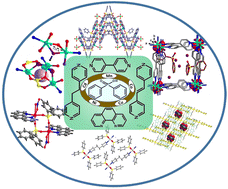
A series of coordination complexes derived from diphenylphosphinic acid (DPP) and transition metal ions (Mn(II), Co(II), Ni(II), Cu(II), and Cd(II)) were developed in the presence of various N-donor ligands, including 4,4′-bipyridine (bpy), 1,2-bis(4-pyridyl)ethane (bpyea), 1,2-bis(4-pyridyl)ethene (bpyee), and 1,10-phenanthroline (phen). The resulting structures unveil monomeric, dimeric, and polymeric frameworks, demonstrating the rich structural diversity achievable with phosphinate coordination chemistry. Single-crystal X-ray diffraction analysis revealed variable metal coordination environments—ranging from distorted octahedral to square pyramidal geometries—and highlighted the versatile and intriguing binding modes of DPP, particularly the formation of M–(O–P–O)2–M eight-membered rings and pseudo-chelating motifs. Notably, rigid co-ligands such as phen result in discrete or dimeric units, while linear spacers like bpy and bpyea facilitate polymeric chain and extended framework development. Solvothermal and ambient crystallisation conditions produced distinct structural outcomes, with cases of polymorphism and framework interconversion observed. Non-covalent interactions, especially hydrogen bonding and π–π stacking, significantly influence the crystal packing pattern and are responsible for the stability of the network solids. These findings highlight the potential of phosphinate-based ligands in constructing coordination networks with tunable dimensionality and topology, thereby expanding the utility of organophosphorus ligands in secondary building unit (SBU) formation and advancing the rational design of supramolecular architectures.
 Please wait while we load your content...


