


 PLATFORM UPDATE:


Tracking in situ transformation of metal–organic frameworks into layered double hydroxides during synthesis and alkaline water oxidation through operando mechanistic studies

Abstract
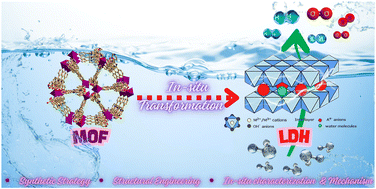
Metal-organic frameworks (MOFs) have become powerful precursors for generating layered double hydroxides (LDHs) with excellent oxygen evolution reaction (OER) activity, yet the mechanistic pathways guiding their transformation remain unclear. Existing reviews largely emphasize synthetic routes and performance metrics, leaving the real-time structural and chemical evolution of MOF-derived LDHs fragmented. This work fills that gap by providing the focused overview of the in situ/operando mechanisms that govern MOF-to-LDH conversion and their electrocatalytic function. We summarize the fundamentals of water oxidation, outline the chemical principles that drive LDH formation from MOFs, and highlight how phase evolution under synthetic and electrochemical environments dictates OER activity. Advances in in situ/operando characterization, Raman spectroscopy, Attenuated Total Reflectance Fourier-transform infrared (ATR-FTIR), Electrochemical Impedance Spectroscopy (EIS), X-ray absorption spectroscopy (XAS), X-ray photoelectron spectroscopy (XPS), liquid-cell transmission electron microscopy (LCTEM), etc., are integrated with DFT insights to construct a unified picture of intermediate species, structural dynamics, and thermodynamic stability. We further discuss how defect chemistry, metal-oxygen flexibility, and dissolution-reprecipitation behaviour shape durability under harsh OER conditions. The perspective concludes with key challenges and future opportunities for mechanistically guided design of next-generation MOF-derived LDH electrocatalysts.
- This article is part of the themed collections: 2026 Frontier and Perspective articles and Dalton Transactions: HOT Articles
 Please wait while we load your content...


