


 PLATFORM UPDATE:


Canonical Zn–Zn pseudo-triple bond with double aromaticity in D5h-Zn2Na5− cluster
 *b
*b
Abstract
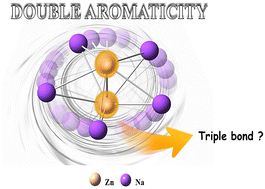
In transition metals, the formation of intermetallic multiple bonds typically depends on d-orbital coupling. However, zinc, with its fully occupied 3d electron shell, struggles to form multiple bonds via this pathway, rendering Zn–Zn triple bonds exceptionally rare. Here, we propose, in theory, an all-metal global-minimum anion cluster, D5h-Zn2Na5−. D5h-Zn2Na5− exhibits a pseudo yet canonical Zn–Zn triple bond with pronounced electron delocalization as well as dual aromaticity, including cubic aromaticity across the entire skeleton, and σ aromaticity only belongs to the pentagonal and equatorial Na5− ligand framework. This unique Zn2 bonding motif and electronic structure emerge in the absence of axial ligand coordination, representing a rare example of dual aromaticity in an all-metal system. Bonding analysis reveals that this novel bonding model comprises two orthogonal delocalized π bonds formed through partial electron transfer from the equatorial Na ligands to Zn 4p orbitals, along with a delocalized quasi-σ bond with a little Zn–Zn interaction. Furthermore, comparative studies reveal that the σ-aromaticity of the planar Na5− ring ligands is more potent than that of the planar Li5− ring, which dominates the D5h geometry of Zn2Na5−, whereas Zn2Li5− adopts a sliding triple bond configuration, whose stability relies on a mixed coordination mode involving both planar and axial lithium atoms. This discovery establishes the strategic design of ligand frameworks as a promising paradigm for stabilizing unconventional multiple bonds and engineering specific aromaticity in multi-metallic clusters.
 Please wait while we load your content...


