


 PLATFORM UPDATE:


Light- and copper-activated (photo)cytotoxicity of 8-hydroxyquinoline-based boron photosensitizers with lipid droplet targeting and lipid peroxidation accumulation

Abstract
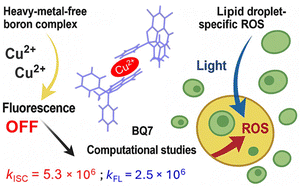
8-Hydroxyquinoline-based tetracoordinate boron complexes have been observed to exhibit pronounced luminescence and light-activated reactive oxygen species (ROS) generation, while their copper(II) analogs demonstrate significant cytotoxic effects in cancer cells. Nevertheless, both types of complexes are hindered by their inherent hydrophilicity, thereby limiting their efficacy in biological applications. Thus, we developed heavy-metal-free photosensitizers (PSs) based on 8-quinolinolato boron complexes, which exhibit light-activated fluorescence emission and ROS generation upon aggregation. The PSs effectively localize within lipid droplets and exhibit immediate and sustained ROS production upon exposure to light, even under hypoxic conditions, leading to lipid droplet-specific peroxidation, which is in accordance with the intracellular location, leading to ferroptosis-like cell death. Moreover, their fluorescence emission is quenched in the presence of Cu2+ ions, and the produced complexes enhance cytotoxicity instead. The photophysical properties of the complexes were comprehensively studied by a combination of experimental measurements, quantum mechanical (QM) and hybrid QM/molecular mechanics (MM) simulations. Thus, this investigation offers insights into new molecular design approaches for multifunctional probes with potential applications in photodynamic therapy and chemotherapy for cancer treatment.
 Please wait while we load your content...


