


 PLATFORM UPDATE:

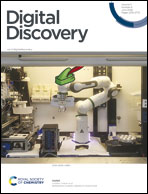
A modular approach to studying polymer processing using a self-driving lab
 a
Dylan J.
Balter,
a
Zhaoji
Yang,
b
Kelsey L.
Snapp,
d
Joseph M.
Palomba
d
and
Keith A.
Brown
*abc
a
Dylan J.
Balter,
a
Zhaoji
Yang,
b
Kelsey L.
Snapp,
d
Joseph M.
Palomba
d
and
Keith A.
Brown
*abc
Abstract
Identifying processing conditions that yield optimal performance in polymer thin films remains challenging. Here we demonstrate a modular self-driving lab (SDL) for optimizing deposition conditions that produce strongly iridescent thin films. The platform combines a six-axis arm to move samples; a spray-coating station based on a re-engineered airbrush with independently actuated needle displacement, air-valve opening, and spray duration; an elliptical imaging station (EIS) that captures four viewing angles in a single image without moving components; and an indexer that sequentially positions wafers for automated transfer. To test this system, we maximized the iridescence of hydroxypropyl cellulose (HPC) thin films using Bayesian optimization. Within an experimental budget of 20 iterations, the SDL identified spray-coating parameters yielding the theoretical maximum iridescence of HPC on Si. Further analysis revealed that films thinner than ∼290 nm exhibit optical behavior consistent with thin-film interference, whereas thicker films deviate from this trend at a thickness corresponding to the minimum cholesteric pitch of HPC, implicating additional contributions from cholesteric ordering. The functionality of the optimized films as signage and optically responsive humidity sensors was verified. This work establishes a modular framework for systematically mapping processing-structure–property relationships in thin-film deposition and autonomous exploration of polymer processing.

- This article is part of the themed collection: 2025 Accelerate Conference
 Please wait while we load your content...


