


 PLATFORM UPDATE:


Constraint-aware labware layout generation from natural language for heterogeneous laboratory robots
 †ab
Takashi
Inagaki,
†c
Akari
Kato,
de
Koji
Ochiai,
d
Kazuya
Azumi,
df
Koichi
Takahashi,
df
Genki N.
Kanda
*eg
and
Haruka
Ozaki
*ah
†ab
Takashi
Inagaki,
†c
Akari
Kato,
de
Koji
Ochiai,
d
Kazuya
Azumi,
df
Koichi
Takahashi,
df
Genki N.
Kanda
*eg
and
Haruka
Ozaki
*ah
Abstract
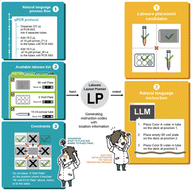
As laboratory automation accelerates scientific discovery, the manual, expertise-driven task of arranging labware on a robot's deck remains a significant barrier for researchers. This initial setup is crucial for experimental success, safety, and efficiency, yet its complexity grows exponentially with protocol intricacy. To address this challenge, we introduce Labware-Layout Planner, a novel system that integrates a Large Language Model (LLM)-based semantic interpreter with a spatial constraint solver. This architecture translates natural language experimental protocols into optimized, robot-agnostic labware layouts. By interpreting user instructions and physical constraints, our system automates the complex decision-making process of where to place each piece of equipment. We demonstrate its versatility through successful execution of diverse experiments: a liquid handling task and a complex qPCR assay on an Opentrons OT-2, and a multi-step cell passaging protocol on a humanoid Maholo LabDroid. Labware-Layout Planner represents a critical advance by tackling the physical setup phase of automation, paving the way for researchers to move seamlessly from a written idea to robotic execution and freeing human intellect for more creative scientific pursuits.
 Please wait while we load your content...


