


 PLATFORM UPDATE:


Multi-stage Bayesian optimisation for dynamic decision-making in self-driving labs
 ab
and
Pascal
Friederich
*ab
ab
and
Pascal
Friederich
*ab
Abstract
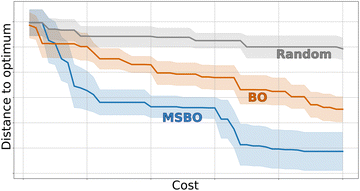
Currently, Bayesian optimisation is the most widely used algorithm for identifying informative experiments in self-driving labs (SDLs). While versatile, standard Bayesian optimisation relies on fixed experimental workflows with predefined parameters and objective functions. This prevents on-the-fly adjustments to operation sequences or the inclusion of intermediate results in the decision-making process. Therefore, many real-world experiments need to be adapted and simplified to fit standard SDL settings. In this paper, we introduce multi-stage Bayesian optimisation (MSBO), an extension to Bayesian optimisation that allows flexible sampling of multi-stage workflows and makes data-efficient decisions based on intermediate observables, which we call proxy measurements. MSBO is designed to address common SDL challenges, such as high downstream characterisation costs, sequential dependencies, and the effective use of proxy measurements. To evaluate this approach, we validate our method using computational simulations and retrospective datasets of chemical discovery, demonstrating its potential to accelerate future SDLs. We systematically compare the advantage of taking into account proxy measurements over conventional Bayesian optimisation, in which only the final measurement is observed. We find that across a wide range of scenarios, proxy measurements substantially improve both the time to find solutions and their overall optimality. This not only paves the way to use more complex and thus more realistic experimental workflows in autonomous labs but also to smoothly combine simulations and experiments in the next generation of SDLs.
- This article is part of the themed collection: 2026 Digital Discovery Emerging Investigators
 Please wait while we load your content...


