A mobile robotic process chemist

Abstract

Process chemistry creates scalable routes for new lead molecules and is a crucial but laborious stage in pharmaceutical and agrochemical development cycles. We have built an automated process chemistry platform that tackles late-stage process development. The modular workflow integrates both industry-standard tools and bespoke devices to enable process scale synthesis, work-up, and analysis. A multitasking mobile robot works between an automated synthesis reactor and an ultra-high-performance liquid chromatography-mass spectrometer (UHPLC-MS) for product analysis, cleaning the reactor between runs. The robot's anthropomorphic manipulation capabilities allow it to interface with minimally redesigned equipment that can be shared with human researchers. Reaction yields and purity match human chemist performance. Timings for round-the-clock, back-to-back experiments suggest that the weekly reaction output of the robot operating multiple reactors could exceed that of a human process chemist by a factor of 12 in an industrial setting.
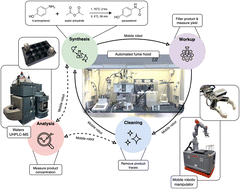
Graphical abstract: A mobile robotic process chemist

Supplementary files

Transparent peer review

To support increased transparency, we offer authors the option to publish the peer review history alongside their article.

View this article’s peer review history

Article information

Article type
Paper
Submitted
16 Dec 2025
Accepted
22 Feb 2026
First published
02 Mar 2026
This article is Open Access
Creative Commons BY-NC license

Digital Discovery, 2026, Advance Article

A mobile robotic process chemist

E. J. Brass, S. Veeramani, Z. Zhou, H. Fakhruldeen, J. S. Manzano, R. Clowes, I. Akpinar, M. R. Ward, J. W. Ward and A. I. Cooper, Digital Discovery, 2026, Advance Article , DOI: 10.1039/D5DD00563A

This article is licensed under a Creative Commons Attribution-NonCommercial 3.0 Unported Licence. You can use material from this article in other publications, without requesting further permission from the RSC, provided that the correct acknowledgement is given and it is not used for commercial purposes.

To request permission to reproduce material from this article in a commercial publication, please go to the Copyright Clearance Center request page.

If you are an author contributing to an RSC publication, you do not need to request permission provided correct acknowledgement is given.

If you are the author of this article, you do not need to request permission to reproduce figures and diagrams provided correct acknowledgement is given. If you want to reproduce the whole article in a third-party commercial publication (excluding your thesis/dissertation for which permission is not required) please go to the Copyright Clearance Center request page.

Read more about how to correctly acknowledge RSC content.

Social activity

Spotlight

Advertisements