


 PLATFORM UPDATE:


Using Flory–Huggins-informed human-in-the-loop Bayesian optimization to map the phase diagram of polymer blends

Abstract
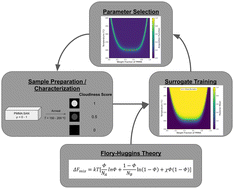
Mapping the phase diagram of polymer blends is an essential step in controlling the structure–property relationship of polymer-based materials. However, traditional grid-based approaches are inefficient and rely on subjective judgements for terminating the experimental campaign. Artificial intelligence-guided experimentation offers a compelling alternative, especially when data-driven decision-making is interfaced with established polymer thermodynamics to improve efficiency and interpretability. Here, we introduce a physics-informed Bayesian optimization approach to guide the mapping of the phase diagram of a model blend containing poly(methyl methacrylate) and poly(styrene-ran-acrylonitrile). Physical information is derived from a Flory–Huggins representation of the spinodal curve, which is integrated into the Bayesian optimization process as a structured prior mean that acts as a soft constraint. Implemented as a human-in-the-loop workflow, the approach leverages optical imaging of film cloudiness with iterative Gaussian process surrogate modeling and a parameter selection decision policy to identify the composition-temperature conditions for sequential iterations. Convergence of kernel and Flory–Huggins-based hyperparameters provided a stopping criterion, ensuring an objective and interpretable termination of the experimental campaign. The framework recovered the known lower critical solution temperature (∼160 °C), while increasing material efficiency through targeted sampling. This work establishes a proof-of-concept for the application of Bayesian optimization workflows to study polymer blend miscibility.
 Please wait while we load your content...


